
Buoyancy and Emotion Regulation
Buoyancy Energy is in our muscle memory—it’s that set of familiar sensations you feel when floating: a weightless, effortless ease. You can feel it in a body of water, after a great massage, walking in mist or a lovely snowfall, or perhaps you’ve had the experience of receiving wonderful news that causes you to feel like you’re floating on air. When buoyant, your body feels relaxed and oxygen-charged, so that your movements are smooth, easy, and fluid.
Buoyancy and Emotion Regulation
by Dana Smith, Ph.D.

The ability to regulate your own emotions is one of the defining characteristics of emotional intelligence. In today’s world of pandemic, social upheaval, political division, and struggles with mental health, emotional intelligence is perhaps more important than ever. Neuroscientific laboratory experiments conducted during the past thirty years have proven that some degree of emotion regulation is possible through consciously employed physical strategies. A growing amount of evidence suggests that if you can assume the breathing pattern, facial expression, and body attitude of a desired emotion (the Emotional Effector Patterns), you can actually begin to feel that emotion.
For the past seven years, I’ve been researching Lessac Body Energies for their potential in regulating emotion. Those of us who practice Lessac Kinesensics can testify that this work offers many powerful tools for coping with the stresses of the day, and one of the most effective tools is Buoyancy Energy. Buoyancy is one of the four natural human body climates in Lessac work, which may be harnessed at any time to enhance any human activity.
Buoyancy Energy is in our muscle memory—it’s that set of familiar sensations you feel when floating: a weightless, effortless ease. You can feel it in a body of water, after a great massage, walking in mist or a lovely snowfall, or perhaps you’ve had the experience of receiving wonderful news that causes you to feel like you’re floating on air. When buoyant, your body feels relaxed and oxygen-charged, so that your movements are smooth, easy, and fluid.
Buoyancy Energy can calm the spirit and promote a feeling of well-being. There’s a physiological reason for that. Explorations in Buoyancy can inspire some elements of an Emotional Effector Pattern, one of six core emotions identified by Chilean neuroscientists in the 1970s. Although feelings are highly subjective and words are insufficient, the general category of emotion I experience most often when working in Buoyancy is the feeling of tenderness or tender love. Others have called it: serenity, affection, peace, and calm contentment. Whatever you call it, this emotion (like the other five core emotions) can be induced through physical means.

I’ve observed that the Emotional Effector Pattern for tender love happens naturally when I move my body buoyantly, as if I were floating. In this pattern, breathing is through the nose. The exhalation is just a beat or count longer than the inhalation. After you exhale, there’s a slight pause or rest before the next inhale begins. Laboratory studies have proven that this breathing pattern lowers the heart rate, blood pressure, and other physiological markers, as well as slowing the release of stress hormones.
One Buoyancy exploration we frequently turn to in Lessac work is called, “wafting and waving”; while standing with shoulder-distance between your feet, you allow your torso to slide (waft) right and left and back again, over and over, in an easy flowing rhythm. Shoulders and hips move together, side to side. This action encourages the tilting of the head to one side—another element of the Effector Pattern for tenderness. You can enhance the experience of wafting and waving into tender love by relaxing your face into a closed-mouth smile, as tiny facial muscles around the mouth and eyes yawn toward the ears. The muscles in the cheeks also move up and back. A final conscious adjustment would involve the slight curling of the rib cage with the head tilt. The whole body is relaxed and open.
Emotion regulation doesn’t mean that you shouldn’t feel what you feel; there is a rightful place for all emotions in our lives. But if you find yourself getting stuck in an unwanted emotion, and are looking for ways to cope, Buoyancy Energy offers a way through. In Essential Lessac, Master Teacher Deb Kinghorn proposes something she calls, “love energy”: “the pervasive sensation of well-being so thoroughly fills experience that it becomes a concrete physical sensation, perhaps not unlike flow or being in the zone.” To me, this sounds like Buoyancy, coupled with the Emotional Effector Pattern for tenderness or tender love.
The world can be a scary place. We pay a price for holding onto conflict and tension, and the cost is to the human bodymind. Feeling anxious? Stuck in traffic or in a long and slowly moving line at the end of the day? Or do you find yourself exhausted by people who are stressed and angry? I recommend a little Buoyancy.

Dana Smith, Ph.D.
Newsletter Editor, LTRI, Lessac Certified Trainer
Professor, Chair of Theatre, Truman State University

THE LESSAC INTERNATIONAL CONFERENCE, JANUARY 2020
Our readers are cordially invited to attend the 2020 Lessac Training and Research Institute ® International Conference, which will be held January 9-11, 2020, at Kent State University in Ohio. The conference is for anyone interested in improving the quality of their voice and body communications, and the work can be applied to any life endeavor. (Read more)
THE LESSAC INTERNATIONAL CONFERENCE, JANUARY 2020

Our readers are cordially invited to attend the 2020 Lessac Training and Research Institute ® International Conference, which will be held January 9-11, 2020, at Kent State University in Ohio. The conference is for anyone interested in improving the quality of their voice and body communications, and the work can be applied to any life endeavor. The theme of the conference is: “Reflect and Renew: Lifting Voices to Affect Positive Change,” as we celebrate the power of the human instrument as a conduit for grounded, positive, and peaceful communication. Conference participants will have the opportunity to engage in a wide variety of dynamic, experiential workshops, paper presentations, and panel conversations. Workshops will explore how Lessac energies intersect with various acting techniques, such as Shin Somatics movement, the neuroscience of emotions, and Viola Spolin’s improvisation work, to name a few. One panel discussion will cover how Kinesensics may be used with women in pregnancy, labor, delivery, post-partum, and beyond, to both empower and support them. Among the paper presentations is one that will examine how and why Lessac body energies prepare actors for film, television, and voice-over success. You’ll be given the chance to experience basic lessons in kinesensic energies and principles. The conference environment is also ripe for forging and developing new professional and personal connections.
What presenters are saying about the conference:
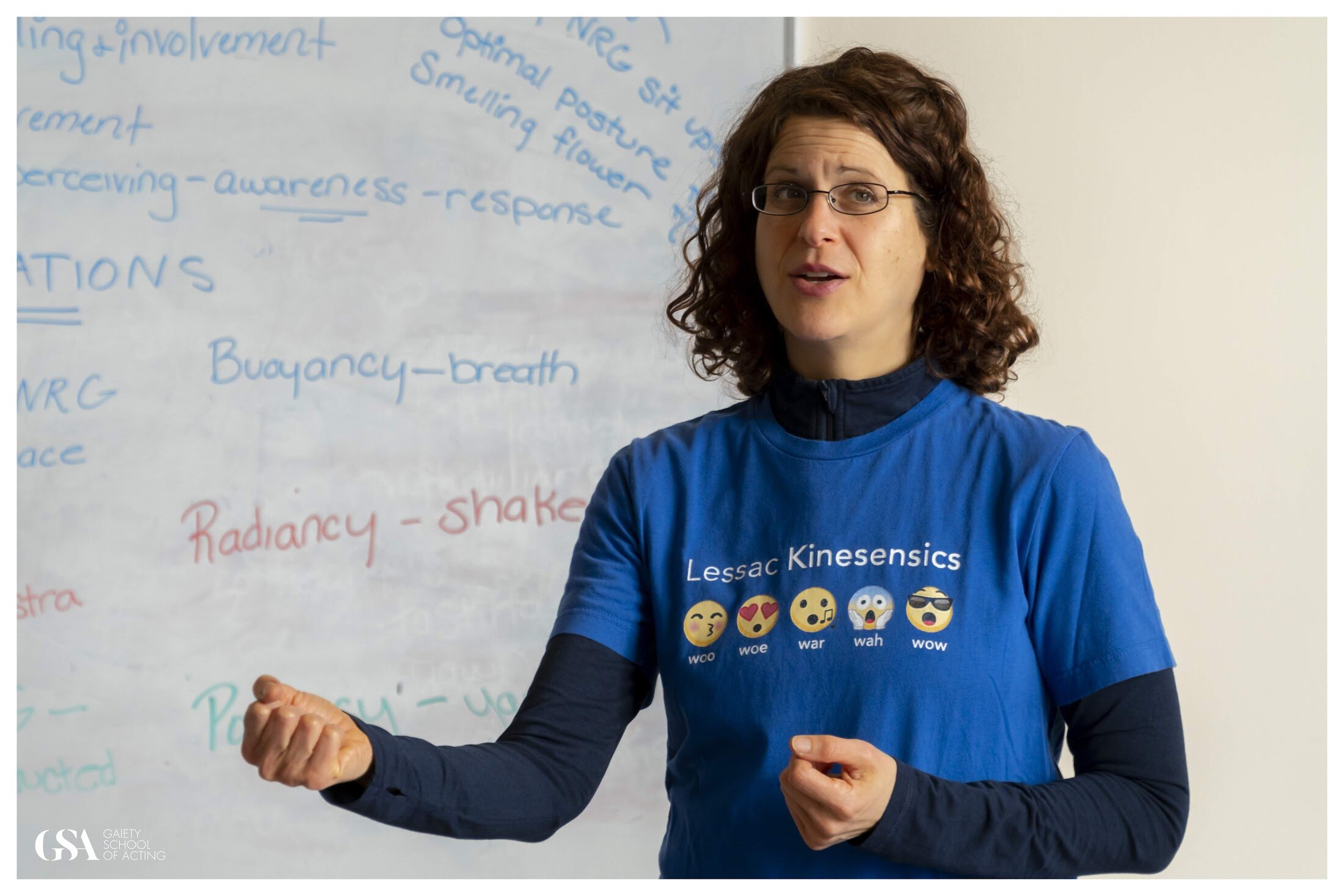
Robin Aronson
Certified Trainer
Immediate-Past President, LTRI
“I am really looking forward to the upcoming 2020 Conference at Kent State. During the conference, I will be co-presenting with my dance colleague, Kelly Ferris Lester from Southern Miss. Our workshop will be exploring the commonalities of Shin Somatics movement work and Lessac Kinsesensic training to enhance and deepen creative expression. In addition to presenting, I also am excited to see others share their current research practices. The Lessac conference is such a lovely way to meet new people interested in the work as well as spending time with Lessac Master Teachers, friends and colleagues. I sincerely hope you will consider attending!”
-Robin Aronson, Immediate Past President LTRI
"The Lessac Conferences have been a font of information for me through the years. Every time I go I pick up valuable Lessac-inspired applications that I have immediately put into use in my direction, classroom, and coaching. The value of this conference cannot be beat; and the intimate, generous community of players in the Lessac world continues to nourish and support anyone interested in any aspect of this holistic training. I want to personally reach out and encourage anyone curious about the work to contact me if you have questions about whether this conference would be right for you to attend this year. crystal.robbins@lessacinstitute.org"
-Crystal Robbins, Master Teacher LRTI
More about the conference:
Kent State University’s School of Theatre and Dance is, in part, hosting the 2020 conference. 2020 marks the 50th year since the tragic events that took place on May 4, 1970 at Kent State University. The university has arranged a variety of special commemorative events available to the public between through May 4, 2020. For more information on the scheduled events, special programs, and educational opportunities, please visit the 50th Commemoration website.

Click here for more information about the conference and registration, please see our website: