
Rooting into BodyVoice: Lessac 5-Day Workshop Comes to Fresno, January 2026
In January 2026, California State University, Fresno will host a transformative five-day Lessac Kinesensic BodyVoice workshop led by two accomplished facilitators, Michelle Bellaver and Crystal Robbins. From January 5–9, 2026, participants will immerse themselves in a week of vocal, physical, and creative exploration designed to restore a deep connection between body, voice, and self.
Rooting into BodyVoice:
Lessac 5-Day Workshop Comes to Fresno, January 2026

In January 2026, California State University, Fresno will host a transformative five-day Lessac Kinesensic BodyVoice workshop led by two accomplished facilitators, Michelle Bellaver and Crystal Robbins. From January 5–9, 2026, participants will immerse themselves in a week of vocal, physical, and creative exploration designed to restore a deep connection between body, voice, and self.
For Crystal Robbins, a Master Teacher in LK BodyVoice with decades of experience, the workshop is more than a set of exercises—it’s a return to human sensing and feeling. “This one-week workshop is a gateway to rediscovering sensing and feeling as a human, which directly leads to how we sense and feel our bodyvoice,” she explains. “We seek power without pain and strength without strain… Want to find your strong, powerful voice and know you have the tools to safely use it in all situations? This is for you.”
Robbins describes the week as a safe space to reconnect with the body’s natural design for ease and well-being. Through guided somatic prompts and Lessac’s science-backed principles, participants learn to notice and shift habitual patterns that may limit freedom in both body and voice. “Lessac Kinesensics Bodyvoice work can open many doors to not just the authentic voice, the expressive body, but the will and power to truly live a life worth living,” she says.
Michelle Bellaver, a Certified Trainer in LK BodyVoice and Assistant Professor of Acting and Directing at CSU Fresno, sees the week as an essential opportunity for artists to break free from rigid performance prescriptions. “As performers, we often are prescribed the ‘how’ we should use performance techniques to better access our creativity,” she notes. “But the best and most essential training leads us away from the prescribed ‘how’ and closer to the freedom to experiment with methodology and technique.”
Bellaver emphasizes the role of Kinesensics in deepening the artist’s awareness from within. Through work with the spine, breath, movement, and voice, participants explore Inner Harmonic Sensing, Optimal Breath, and Dynamic Alignment. Guided experiments in the classic Lessac repertoire—Body Relaxer-Energizers, Body Esthetics, Body NRG’s, and Vocal NRG’s—help attendees access their authentic expressive BodyVoice. “Participants are guided with care and warmth to find their authentic expressive Bodyvoice,” she says, underscoring the workshop’s supportive environment.
Workshop Experience
The Fresno Lessac workshop blends large-group body-voice-breath classes, small-group vocal focus, and one-on-one coaching. Attendees also receive four months of asynchronous video access, extensive Google Classroom resources, and may decide to apply for entry into Level 1 certification candidacy. The program is open to actors, educators, wellness professionals, and anyone seeking a more vibrant, connected relationship with their voice and body.
For both Bellaver and Robbins, the aim is clear: to empower participants to leave not only with practical tools, but also with a renewed sense of possibility. As Robbins puts it, “We must know what we feel, before we know to apply in context.” And this workshop offers the space, expertise, and community to make that discovery last a lifetime.
Register for the 5 Day Workshop in Fresno here: https://www.lessacinstitute.org/fresno-workshop

New LTRI Publication: "Sensing Speech"
The Lessac Institute is thrilled to announce the release of "Sensing Speech: A How-to Manual for those wishing to speak General American English Easily, Articulately and Expressively through a Feeling-based process," a new book by Jonghee Shadix and Nancy Krebs.
New LTRI Publication: "Sensing Speech"

The Lessac Training and Research Institute is thrilled to announce the release of "Sensing Speech: A How-to Manual for those wishing to speak General American English Easily, Articulately and Expressively through a Feeling-based process," a new book by Jonghee Shadix and Nancy Krebs.
The Choice in Accent Acquisition
"Sensing Speech" offers a somatic approach to accent acquisition within a TESOL context (Teaching English to Speakers of Other Languages). This manual utilizes the Lessac Kinesensics process of sensing and feeling effective use of voice and speech in context. In particular, this manual empowers speakers with the awareness and skills to make conscious feeling-based choices when speaking General American English.
“Sensing Speech” provides tools and means to shift towards a General American accent when desired without the pressure of accent reduction. The authors respect the desire of those who wish to maintain their unique vocal sounds and patterns, including accents, when speaking English. At the same time, they recognize some may wish to acquire a more General American accent towards effective communication in chosen contexts within the United States or regions where General American is prevalent.
A Unique Approach: Kinesensics
Kinesensics is a somatic approach offering embodied and ‘envoiced’ strategies towards effective behavior and communication. Kinesensics honors individuality and uniqueness, guiding the speaker to find their authentic voice. "Sensing Speech" draws from this approach.
The Authors' Expertise

Jonghee Shadix's personal journey inspired this book. When working as a registered nurse in the United States, she became aware of the need for General American accent acquisition towards effective communication. She chose to pursue a master's degree in Teaching English to Speakers of Other Languages (MA-TESOL). This led to teaching English as a second language to international graduate students, which included accent acquisition.

Nancy Krebs, a Lessac Kinesensics Master Teacher and experienced actor/singer, voice teacher, and dialect coach, co-authored the book with Jonghee, integrating Lessac Kinesensic strategies into the accent acquisition process.'.
Where to Find It
"Sensing Speech" is available for purchase on Amazon, Barnes & Noble Booksellers and Apple Books


Remembering Master Teacher Dick Cuyler
It is with profound sadness that we announce the passing of Dick Cuyler, a beloved Lessac Master Teacher and a true pioneer of our work. Dick passed away on Tuesday, March 18, 2025, peacefully and with his dear Saundra by his side.
Remembering Master Teacher Dick Cuyler
(Original Post March 20, 2025)
It is with profound sadness that we announce the passing of Richard “Dick” Cuyler, a beloved Lessac Master Teacher and a true pioneer of our work. Dick passed away on Tuesday, March 18, 2025, peacefully and with his dear Saundra by his side. He was 93 years-young.
Arthur Lessac (left) and Dick Cuyler (right) teaching at SUNY Binghamton circa. 1970s
Dick was a cornerstone of the Lessac Institute, a member of the "original team" who worked directly with Arthur and Sue Ann to develop and disseminate Lessac Kinesensics. His dedication and expertise were invaluable to our community.
Dick's background was as rich and diverse as his talent. He held a BA in English Literature from Oberlin College, an MA in Directing from Bennington College, and a degree in Voice and Speech from Columbia University Teachers College. He was a true polymath of the performing arts.

Dick Cuyler, clowning around (2000s)
His theatrical training included studies with luminaries such as Uta Hagen, Gene Frankel, and Robert Lewis, and he was an observer at the Actors Studio. Beyond acting and voice, Dick possessed a remarkable array of physical performance skills, including mime, tumbling, clown work, juggling, and unarmed combat. He was a member of Actors Equity, SAG-AFTRA, and the International Jugglers Association, alongside his membership in the Lessac Institute.
Dick's teaching career was extensive and impactful. He shaped the lives of countless students at Skidmore College, where he served as department chair, and at Binghamton University, where he taught for 20 years. He also shared his knowledge through Lessac intensives at numerous institutions, including the University of Minnesota Duluth, the University of Colorado Boulder, Central University in Pella, Iowa, and SUNY Fredonia. In his later years, he continued to teach at the Flat Rock Playhouse's Youth Theater and the Chautauqua Institution.
Dick's contributions to Lessac Kinesensics and performing arts as a whole are immeasurable. His legacy will live on through the countless students and colleagues he inspired.
He is survived by his loving wife, Saundra Cuyler, a valued member of the Lessac Institute. Our hearts go out to Saundra and all of Dick's family and friends during this difficult time.
We will share information regarding memorial services and tributes as it becomes available. Please join us in remembering and celebrating the life of Dick Cuyler.
With appreciation,
The LTRI
*Please share your memories of Dick in the comments below.
Learn more about Dick’s life and his contributions to the legacy of Lessac Kinesensics in his 2020 Interview with fellow Master Teacher Deb Kinghorn.

The Lessac Training - An Invitation to Balanced, Holistic BodyVoice Training
Lessac Kinesensics offers a holistic approach to integrating voice and body for performers, enhancing authentic expression, seamless transitions between singing and speaking, and overall creative confidence. Actors, singers, educators, speech-language pathologists - and more - report transformative experiences in Lessac training programs.
The Lessac Training - An Invitation to Balanced, Holistic BodyVoice Training
Lessac Kinesensics: A Holistic Approach to Voice and Body in Performance
Lessac Kinesensics offers a holistic approach to integrating voice and body for performers, enhancing authentic expression, seamless transitions between singing and speaking, and overall creative confidence. Actors, singers, educators, speech-language pathologists - and more - report transformative experiences in Lessac training programs, noting expanded vocal range, increased flexibility, and a deeper understanding of their unique vocal “fingerprint.” This training not only improves performance skills but also provides tools for protecting and sustaining voice and body in diverse contexts, fostering greater musicality in speech, improved communication, and enriched self-expression for both individual and collaborative work.

“Each person brings their own goals, desires, and aspirations to the training, and the training responds to those needs”
Participants at the 2022 USA Intensive at DePauw University
Grounded in Science and Health
Lessac Kinesensics is grounded in the science of health and well-being. Individuals tackling physically or vocally demanding roles discover healthy strategies to help them navigate these challenges while protecting their voice and body, without sacrificing their creative expression. And this approach doesn’t stop at the stage. The principles of Lessac Kinesensics can be applied to everyday life. We encourage workshop participants to become solution builders for their own communication challenges. Our workshops build on foundational skills in body and vocal awareness, culminating in practical applications. This step-by-step approach ensures participants have time to fully integrate what they’re learning and apply it to their unique personal and professional goals.
A Personalized, Holistic Experience
One of the most exciting aspects of Lessac Kinesensics is its focus on individual growth. Each person brings their own goals, desires, and aspirations to the training, and the training responds to those needs. The model allows for open-ended exploration, encouraging each person to take ownership of their learning. This personalized approach respects the lived experiences of each participant while helping them develop their voice and body as an integrated instrument.
Trainers are well-versed in issues of inclusion, diversity, equity, and accessibility, ensuring the space is not only supportive but actively engaged with the real-world challenges individuals may face in their personal and professional lives. The result is an empowering environment that nurtures growth in a way that is sensitive to each participant’s unique experience.
The New Era of Lessac: Integrating Tradition with Innovation
While Lessac Kinesensics has been around for decades, the training style has evolved significantly since the 1970s. Today’s training reflects a global perspective, inspired by international partners and rooted in a commitment to justice and equity. It offers participants a chance to explore somatic-based, integrated bodyvoice training, blending voice, body, mind, and acting skills into a cohesive learning experience.
The work is slow, intentional, and deeply connected to the body’s organic movements and vibrations. Workshop participants often find that their habitual patterns and tensions begin to release, making way for new neural pathways that support optimal use of the body and voice. This process leads to significant growth in vocal expressiveness, body flexibility, dynamic alignment, and overall confidence.
Lifelong Learning Through the “Teacher Within”
One of the core principles of Lessac Kinesensics is helping participants connect with their inner “teacher.” This self-guided learning is a powerful somatic tool, allowing participants to continue growing beyond the structured exercises of the program. With newfound awareness of their body, breath, voice, and communication skills, they leave the program more grounded, more self-assured, and ready to tackle challenges with confidence.
Facilitators firmly believe that people who come to the work for voice and body training don’t need to be “fixed.” They may come into the program thinking they have a “problem” with their voice or body, but what they really gain is a new lens through which to see their abilities. Lessac Kinesensics offers them the tools to strengthen their body-voice instrument and create solutions that are unique to their personal experience.
A Training Program for Growth and Empowerment
Whether you’re looking to expand your vocal range, refine your physical experience, or simply gain more confidence in expressing yourself, Lessac Kinesensics offers a holistic and integrated somatic approach to body-voice training. It’s not just about improving your skills on stage—it’s about connecting with your body and voice in a way that supports lifelong learning and growth.
Participants in Lessac Intensive Workshops leave with a deeper understanding of their own instrument and a renewed sense of agency. Whether in a classroom, community, or personal setting, they gain tools that allow them to approach challenges with creativity, flexibility, and confidence. Kinesensics is performance training, it is actor training, it is voice and speech training, it is communication training - and much more. If you’re seeking a somatic-based, integrated approach that respects your individual journey while helping you grow as an artist and a person, Lessac Kinesensics may be exactly what you’re looking for.
Find Out More…


Announcing the Facilitators of the 2025 USA Intensive Workshops
Meet Crystal Robbins and Nancy Krebs, Master Lessac Teachers who will be facilitating the Lessac Intensive Workshops in 2025 at DePauw University in Greencastle, Indiana.

Meet Crystal Robbins and Nancy Krebs, Lessac Master Teachers who will be facilitating the Lessac Intensive Workshops in 2025 at DePauw University in Greencastle, Indiana. Here is a little info on them to help you get to know them!
CRYSTAL ROBBINS, California, USA
Crystal Robbins is a Los Angeles-based Master Teacher of Bodyvoice . She has been teaching LK bodyvoice at Santa Monica College since 2000 and has specialized in creating short-format workshops for adults and teachers, K-12 programming of Lessac which she calls Kindersensics and coaches privately in theatre/film/tv/voiceover. She has facilitated at Lessac Intensives since 2015. Crystal was Arthur Lessac's assistant for the last 13 years of his life and brings a unique perspective from that time working with the founder of LK. She was a cofounder and director of the Burbank Youth Summer Theatre Institute (BYSTI) which she modeled after the Lessac Summer Intensive, teaching Shakespeare to children 6-16, culminating in a performance of a play each summer for 9 summers. The variety of her personal clientele extends far beyond traditional performers/speakers. She also coaches professors in other subject areas, business people, content creators and recently has also coached Twitch streamers, most recently voice-coaching a live-streamed production of Romeo & Juliet for a highly successful charity event.
“I help folks find the voice and communication experience they desire. By grounding our process in things we know how to do as functioning humans, we access health and wellness in the bodyvoice that is knowable and repeatable by the client on their own.” - Crystal Robbins
NANCY KREBS, Maryland, USA
Nancy Krebs, Lessac Master Teacher is a professional actor/singer, musician and recording artist. She has been a facilitator and vocal coach since 1980 and has been a Lessac Master Teacher since 2002. She has taught with Arthur Lessac and Sue Ann Park, directed and Co-Directed both national and international LK Intensives as well as countless shorter workshops since 2001, notably the inaugural and second year of the Lessac Australian Intensive (2018-2019) at the National Institute of Dramatic Art (NIDA) in Sydney Australia, and the South African Intensive in Pretoria 2017, directed by Marth Munro, Ph.D. She served as the 2nd President of the Lessac Institute and also is a member of the Master Teacher Team. She has been the vocal/dialect coach for hundreds of professional theatre productions in the Baltimore-Washington region since 1994. Nancy taught a four-year LK-based voice curriculum in the Theatre Department of the famed Baltimore School for the Arts for 39 years and operates her own voice studio—The Voiceworks Studio. She is currently the Resident Voice & Dialect Coach for The Classic Theatre of Maryland (and now Company member in the Acting ensemble) and has been since 2010.
“I just love the Lessac kinesensics and share it in all sorts of capacities, whether private instruction, group work, seminars, short and longer workshops and Intensives. I have found this training to have most if not all of the answers to maintatin healthy awreness of the voice and body functioning, which is invaluable to all those who participate in the training.” - Nancy Krebs
Find out more about the Intensive Workshops here.

Announcement: Tuition Incentives for all 2024 U.S. Intensive Programs
Have you heard? We are offering tuition underwriting for all 2024 U.S. Intensive workshop offerings through APRIL 30.
1-Week: June 10-15 (Full rate $1,250) - new rate $875
2-Week: June 10-22 (Full rate $2,250) - new rate $1,250
4-Week: June 10-July 5 (Full rate $4,500) - new rate $3,150
Have you heard? We are offering tuition underwriting for all 2024 U.S. Intensive workshop offerings through APRIL 30.
1-Week: June 10-15 (Full rate $1,250) - new rate $875
2-Week: June 10-22 (Full rate $2,250) - new rate $1,250
4-Week: June 10-July 5 (Full rate $4,500) - new rate $3,150
*housing included
**This offer may not be combined with previous financial awards awards or other offers.

INTRO TO LESSAC KINESENSICS
JUNE 10-15
INTRO TO LESSAC KINESENSICS + DEEPER DIVE
JUNE 10 - 22
FOUR WEEK INTENSIVE
JUNE 10 - JULY 5
HENDRIX COLLEGE
CONWAY, AR
(Housing included)
* Lessac Kinesensics is an ISMETA Approved Training Program, and upholds the highest standards of practice in somatic education.

Embark on a Holistic Journey: Lessac Intensive 2024 Returns to Conway, AR
The Lessac Training and Research Institute is pleased to announce that its 2023 U.S. Intensive is taking place in-person at Hendrix College in Conway, AR from June 11-July 7 with a new format. Modeling its structure after the recent South Africa Lessac Intensive which took place in Pretoria in January, our U.S. Intensive will offer tiered options enabling participants flexibility to join for 1-Week, 2-Weeks or the full 4-Week experience. Each week will build upon the previous week’s explorations, culminating in advanced work for self and performance contexts.

Embark on a Holistic Journey: Lessac Intensive 2024 Returns to Conway, AR

2023 Participant explore for their final project
The Lessac Training and Research Institute is pleased to announce that its 2024 U.S. Intensive will return to Hendrix College in Conway, AR, from June 10 to July 5. This immersive experience will cover content from Arthur Lessac’s texts The Use and Training of the Human Voice, and Body Wisdom: The Use and Training of the Human Body, and share the ongoing evolution of the training to reflect current research in bodyvoice knowledge. Led by two Master Teachers, the Intensive offers in-depth instruction in Lessac Kinesensics, which is a comprehensive and creative approach to all aspects of developing the body and voice in a healthful, holistic way. Space is limited, so early registration is encouraged.
Lessac Intensives offer tiered options, allowing participants to join for an introductory 1-week workshop, a 2-week workshop that dives deeper into self-application of the work, or the full 4-week experience. Each week will build upon previous explorations, culminating in advanced work for personal growth within performance contexts. The work with scripted text prepares participants of all professions and vocations for freedom as they express themselves.
Option 1: One-Week Intensive (June 10-16)
Intro to Lessac Kinesensics for personal well-being and application toward a heightened self-awareness.
Option 2: Two-Week Intensive (June 10-23)
A deeper dive into self-discovery with exploration into how we express ourselves physically, vocally, and energetically in a range of situations.
OPTION 3: FOUR-Week Intensive (June 10-July 5):
Creating advanced self-awareness and progression with the skills of the Lessac bodyvoice work, culminating in performance applications for use in various vocations and professions.
*Tuition assistance and reductions are available for all of our workshops.
The workshops will be led by Master Teachers Marth Munro (Pretoria, South Africa) and Nancy Krebs (Baltimore, MD, USA). Both facilitators bring years of experience, passion, and dedication to somatic learning, and the authentic expression of self through Kinesensic bodyvoice training. The 4-week intensive will run concurrently with the Lessac Facilitator Training workshop for Certification Candidates embarking on the final stages of Lessac Certification, led by Master Teacher Deb Kinghorn.
ABOUT THE INSTRUCTORS

Marth Munro, PhD
Lessac Master Teacher
Pretoria, South Africa

Nancy Krebs
Lessac Master Teacher
Baltimore, MD, USA

Deb Kinghorn
Lessac Master Teacher
Florida, USA

Marth Munro facilitating at the 2023 U.S. Intensive
Marth Munro
Marth Munro, PhD, serves as a Professor Extraordinaire in the School of the Arts: Drama at the University of Pretoria, South Africa. She is committed to contributing to decolonising Performing Arts Pedagogies and Praxis. She facilitates workshops for Wits Business School: Executive Education, for example, Emotionally Competent Communication; Equality, Diversity, Inclusivity & Belonging; and Stress pro/resilience. In addition to being a Master Teacher of Lessac Kinesensics, Marth is a certified Laban/Bartenieff Movement Analyst, a Certified Sound Therapist, a qualified Hatha Yoga teacher, an Emotional Body Apprentice, and a certified NLP practitioner. She also has expertise in Bio-and-Neurofeedback. She is a Registered Somatic Movement Educator (ISMETA) and a Registered Life Coach (ICR). Marth specializes in bodymind and voice in behavior and performance. She has published extensively in the field of Embodied Performance Pedagogy and has taught in South Africa, the USA, and Croatia. With a childlike curiosity, Marth plays with purpose and joy.
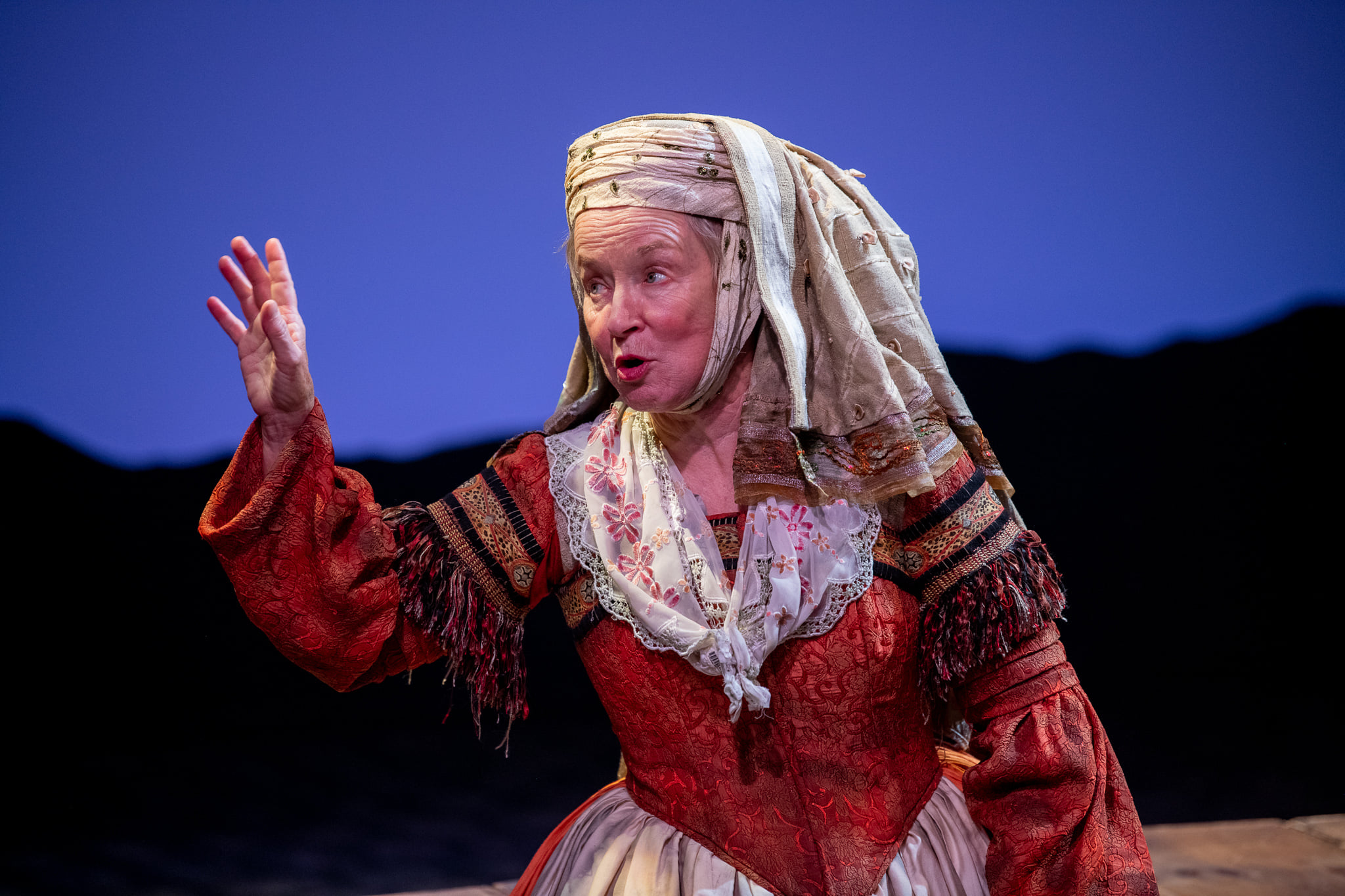
Nancy Krebs in action
NANCY KREBS
She has been a Certified Lessac Master Teacher since 2002. She has served in many capacities for the Lessac Training & Research Institute since that year—as President, Board member, and Master Teacher Council representative. She received the Lessac Leadership Award in 2011 and continues to be a part of the Master Teacher Team. She has been the Director and Co-Director of Lessac Intensives both in the U.S. and abroad; has served on the faculty of the Four Week Workshop, teaching with Arthur Lessac and Senior Master Teacher Sue Ann Park from 1995-2005; and has led and developed numerous shorter Kinesensic-based workshops throughout the years since 1995. She has been a vocal/dialect coach for over 150 professional and university productions in the Baltimore-Washington region since 1994. She taught a full four-year Lessac-based voice curriculum in the Theatre Department of the Baltimore School for the Arts from 1981-2019 and currently operates her own voice studio—The Voiceworks Studio.

Deb Kinghorn exploring Body NRGs
DEB KINGHORN
Deborah Kinghorn is Professor Emerita at the University of New Hampshire, where she was co-director of Acting and Directing and taught courses in beginning and advanced acting, voice, movement, audition, and period and style as well as directing a variety of styles of plays. She is a Master Teacher of Lessac Kinesensic Bodyvoice Training and has facilitated workshops in Kinesensics in Croatia, South Africa, Brazil, England, Puerto Rico and Finland. She is a Fulbright Scholar and received two Excellence in Teaching awards, one from the University of Houston, and one from UNH. She co-authored, with Arthur Lessac, the book “Essential Lessac: Honoring the Familiar Body, Spirit, Mind,” which provides simple yet concrete instruction toward physical and vocal well-being. She continues to perform, most recently as Gertrude in Hamlet for Mount Union’s “Shakespeare at the Castle.” She currently resides with her husband in Florida.
ABOUT ThE ON-SITE COORDINATOR

Antonio Horne
On-Site Coordinator
Lessac Certification Candidate
Associate Professor of Theatre Arts, Hendrix College
Antonio Horne, a proud native of Memphis, TN, is an Associate Professor in the Department of Theatre Arts and Dance at Hendrix College. He holds an MFA in Directing from the University of Memphis, an MBA in Arts Management from UCLA and a BFA in Musical Theatre Dance from the United States International University (now Alliant International). He completed his high school studies at the North Carolina School of the Arts with a focus in Dance. Antonio currently serves as an At-Large member of the Executive Committee for the Musical Theatre Educators’ Alliance.
Antonio is an award-winning stage director whose professional directing credits include Gem of the Ocean; The Color Purple; The Mountaintop; The Legend of Georgia McBride; The Wiz; and The House That Will Not Stand. In addition to teaching and directing, his work encompasses arts management, community arts education, performance, and choreography. Professor Horne has a deep passion for using theatre to provoke, educate, and entertain by giving voice to marginalized and underrepresented populations. His research, teaching, and service are rooted in his strong belief that theatre can affect great change in the world.
STILL HAVE QUESTIONS? Join us for a Live Q&A on March 16.
Please join us on Saturday, March 16 at 12:30 pm EDT (New York) for a live Q&A session on Zoom. Marth Munro and Nancy Krebs will be on hand to answer your questions about the training, the intensive schedule, format and curriculum, the facilities at Hendrix College, how to apply for tuition assistance, and anything else you’d like to ask about our workshop offerings.
Registration is required so please sign up here: REGISTRATION


Meet the Facilitators of the 2023 Lessac U.S. Intensive Workshops
The Lessac Training and Research Institute is pleased to announce that its 2023 U.S. Intensive is taking place in-person at Hendrix College in Conway, AR from June 11-July 7 with a new format. Modeling its structure after the recent South Africa Lessac Intensive which took place in Pretoria in January, our U.S. Intensive will offer tiered options enabling participants flexibility to join for 1-Week, 2-Weeks or the full 4-Week experience. Each week will build upon the previous week’s explorations, culminating in advanced work for self and performance contexts.
Meet the FACILITATORS of the 2023 Lessac U.S. Intensive Workshop
Marth Munro, PhD
Lessac Master Teacher
Pretoria, South Africa

Crystal Robbins
Lessac Master Teacher
Los Angeles, CA, USA
The Lessac Training and Research Institute is pleased to announce that its 2023 U.S. Intensive is taking place in-person at Hendrix College in Conway, AR from June 11-July 7 with a new format. Modeling its structure after the recent South Africa Lessac Intensive which took place in Pretoria in January, our U.S. Intensive will offer tiered options enabling participants flexibility to join for 1-Week, 2-Weeks or the full 4-Week experience. Each week will build upon the previous week’s explorations, culminating in advanced work for self and performance contexts.
1-Week (June 11-17): Intro to Lessac and self-discovery
2-Week (June 11-24): Digging deeper into self and performance contexts
4-Week (June 11-July 7): Advanced self and performance applications
The workshops will be by Master Teachers Marth Munro (Pretoria, South Africa) and Crystal Robbins (Los Angeles, CA USA). Both facilitators bring years of experience, passion, a dedication to somatic learning and the authentic expression of self through Kinesensic bodyvoice training.
ABOUT THE INSTRUCTORS
Marth Munro

Marth Munro explores body dynamics with students in Croatia.
Marth Munro, PhD, serves as a Professor Extraordinaire in the School of the Arts: Drama at the University of Pretoria, South Africa where she is committed to contributing to decolonising Performing Arts Pedagogies and Praxis. She facilitates workshops for Wits Business School: Executive Education, for example, Emotionally Competent Communication; Equality, Diversity, Inclusivity & Belonging; and Stress pro/resilience. In addition to being a Master Teacher of Lessac Kinesensics, Marth is a certified Laban/Bartenieff Movement Analyst, and a Certified Sound Therapist, a qualified Hatha Yoga teacher, an Emotional Body Apprentice, and a certified NLP practitioner. She also has expertise in Bio-and-Neurofeedback. She is a Registered Somatic Movement Educator (ISMETA) and a Registered Life Coach (ICR). Marth specializes in bodymind and voice in behavior and performance. She has published extensively in the field of Embodied Performance Pedagogy and has taught in South Africa, the USA, and Croatia. With a childlike curiosity, Marth plays with purpose and joy.
CRYSTAL ROBBINS

Crystal Robbins participating in movement exploration at the S.A. Intensive
A Master Teacher since 2017, Crystal Robbins just returned from participating and researching at the 2023 South African workshop at the University of Pretoria, South, gleaning much from her colleagues there, not the least of which is how important it is to continually refresh, relearn and challenge one's ways of approaching any work. These echo her 13 years of working with founder Arthur Lessac, who always taught her to explore anew, but this time with a 'just noticeable difference'. With over two decades facilitating the work at university, (Santa Monica College and UCLA-extension), workshops, our intensives, private coaching and in Kinder-12th grade theatre programming, Crystal is excited to partner again with Master Teacher Marth Munro in the application of new formatting for our workshops that feature equity-minded and culturally-relevant practices that meets today's bodyvoice needs while embracing tomorrow's expectations. Crystal considers herself an Abolitionist-Mindset Educator with a focus in disrupting inequities and injustices in facilitation. In addition to her teaching duties at SMC, she was invited to participate in a grant subsidized 2+ year training program focused on equitizing gateway courses, where she is the liaison to her theatre department. Crystal is active in the LTRI on the Master Teacher Team, serving in many capacities, the most exciting of which for her is in mentoring new soon-to-be Certified Trainers. Crystal is based out of Los Angeles.
ABOUT ThE ON-SITE COORDINATOR
Antonio Horne
On-Site Coordinator
Lessac Certification Candidate
Associate Professor of Theatre Arts, Hendrix College
Antonio Horne, a proud native of Memphis, TN, is an Associate Professor in the Department of Theatre Arts and Dance at Hendrix College. He holds an MFA in Directing from the University of Memphis, an MBA in Arts Management from UCLA and a BFA in Musical Theatre Dance from the United States International University (now Alliant International). He completed his high school studies at the North Carolina School of the Arts with a focus in Dance. Antonio currently serves as an At-Large member of the Executive Committee for the Musical Theatre Educators’ Alliance.
Antonio is an award-winning stage director whose professional directing credits include Gem of the Ocean; The Color Purple; The Mountaintop; The Legend of Georgia McBride; The Wiz; and The House That Will Not Stand. In addition to teaching and directing, his work encompasses arts management, community arts education, performance, and choreography. Professor Horne has a deep passion for using theatre to provoke, educate, and entertain by giving voice to marginalized and underrepresented populations. His research, teaching, and service are rooted in his strong belief that theatre can affect great change in the world.
STILL HAVE QUESTIONS? Join us for a Live Q&A on March 11.
Please us on Mach 11, 2023 at 2:30PM EST (New York) for a live Q&A session. Marth, Crystal and Antonio will be live on Zoom to answer any questions you have about about about the format, the application process, financial assistance possibilities, the training, Hendrix college, and anything else you’d like to ask about our workshop offerings.

The Remote Conference Schedule is here! Recorded Sessions for Time Zone Variations!
Announcing the remote conference schedule with recorded sessions for time zone variations! We are offering flexile pay rates to fit your budget and access to recorded sessions to fit your schedule! Can’t make it for the entire live conference? No problem! Come when you can, pay what you can. What are you waiting for?
The Remote Conference Schedule is here!
Recorded Sessions for Time Zone Variations!

January 15-16, 2022
Lessac Training & Research Institute
Online Conference and Research Forum
The Institute’s first ever remote conference is fast approaching! We are offering options to fit you budget and your schedule!
Pay what you can rate options!
Can’t make it for the entire conference? No problem: Attend when you can.
Recorded sessions— recordings of most sessions will be available for a 24-hour period and sent to all registered conference attendees!
What are you waiting for?


Announcing the 2022 U.S. Intensive Teaching Faculty
The Lessac Training and Research Institute is pleased to announce that its U.S. Summer Intensive workshop is scheduled to be back in-person next summer on the campus of DePauw University, and will be led by Master Teacher Crystal Robbins from Los Angeles, CA and Certified Trainer Morné Steyn from Cape Town, South Africa.
Meet the 2022 Lessac U.S. Intensive Workshop Teaching Faculty!
The Lessac Training and Research Institute is pleased to announce that its U.S. Summer Intensive workshop is scheduled to be back in-person next summer on the campus of DePauw University, and will be led by Master Teacher Crystal Robbins from Los Angeles, CA and Certified Trainer Morné Steyn from Cape Town, South Africa.
These talented trainers have been pivotal in the evolution of Lessac Kinesensics and bring their unique perspectives and considerable experience to the workshop; 2022 will mark Crystal Robbins’ 6th year teaching at the U.S. Intensive, and an exciting first for Morné Steyn who has taught the Lessac Intensive in South Africa for several years. We are thrilled to have them both!
The annual 4-week workshop, which took place fully remote last year due to Covid-19, will return to its home at DePauw University in Greencastle, IN, from June 19-July 16, 2022.
About the Instructors
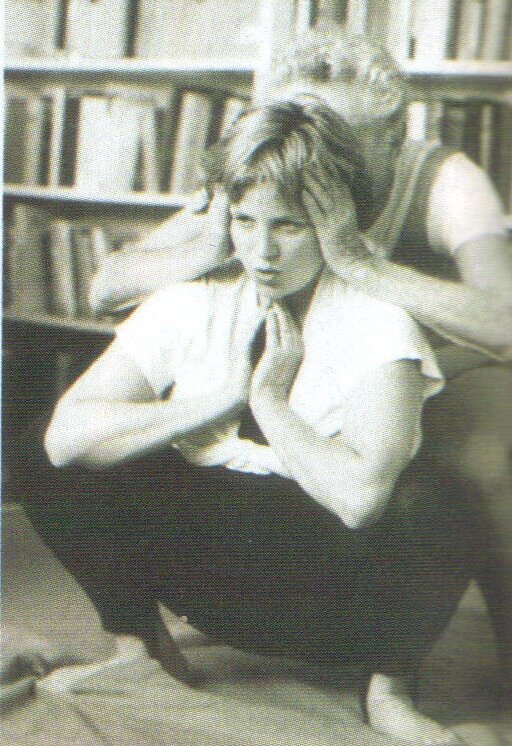
Crystal Robbins and Arthur Lessac in 2000
Crystal Robbins, (University of Memphis, BADA, Oxford, England, LTRI-Master Teacher) has taught Lessac Kinesensics for over twenty years. Her international client base include students, professional speakers/singers/actors/voiceover artists/content creators, and professors in arts and science fields. Crystal worked directly with voice legend Arthur Lessac (1909-2011) the last thirteen years of his life which has directly impacted how she uses the work. She currently teaches at Santa Monica College and at UCLA-extension's Professional Actor Program. She created the application of the work (Kindersensics) to youth and children and developed programming for theatre using it in the K-12 markets, for which she has received multiple grants. Crystal co-developed the Lessac short-form workshop and taught week-long and weekender workshops in multiple US locations and has presented the work at ATHE, VASTA, & LTRI conferences and collaborated internationally on performance art projects. She recently shared the work as an invited panelist for an entirely French-speaking organization on the importance of language learning, bilingual school education and linguistic approaches. A trained performer in film, tv and theatre, Crystal brings her lived experience to her teaching and firmly believes in Kinesensic principles which teach us that when we build off of the natural behaviors we all have within us we gain optimal development of vocal and physical freedom.
Crystal is a member of the Master Teacher Team and is deeply engaged in facilitating the process for new teachers working toward Lessac certification. She is committed to teaching with an Abolitionist and Racial Justice mindset and has been involved in the passionate discussion and action of decolonizing the work through this lens.

Morné Steyn (right) at the 2019 Lessac Intensive in South Africa .
Morné Steyn is a practitioner-scholar and lecturer at the University of Cape's (UCT) Centre for Theatre, Dance and Performance Studies (CTDPS). As a performer, Morné has appeared in a diverse range of professional theatre and film productions in South Africa. He holds an MA (Drama) degree in Gender and Performance Voice studies from the University of Pretoria (UP). Morné’s artistic-research practice is informed by and explores a sensuous approach to knowledge, one which is grounded in a host of global perspectives. This approach aims to explore the intersectional dynamics of a diverse, yet inclusive way of discovering the world through performance. The critical nexus of Morné’s work resides at the performative explorations of race, sex, gender, class and culture in and through performance.
Morné is a Certified Lessac Voice and Movement Teacher as well as a qualified Yoga Instructor. He currently serves as a Board Member of the Lessac Training and Research Institute. Morné has shared his work on bodymind/voice and performance at multiple national and international forums and platforms. He endeavors for his work to contribute towards stimulating an embodied yet critical poetic for inter-relational and postapartheid relationality.
About the Intensive Workshop

Crystal Robbins (front, second left) with the 2019 U.S. Summer Intensive Participants.
You will find opportunities all over the US and the world for learning Lessac Kinesensics, but perhaps the backbone of the Lessac Institute’s offerings is the Intensive Workshop. Although conditions may vary, most of these intensives are conducted in retreat-like settings over three to four weeks so that participants can immerse themselves fully in the process of learning.
The U.S. Lessac Intensive is a four-week workshop. During the first two weeks, students learn about the origins and foundations of Lessac Kinesensics through experiential voice and body work. The last two weeks are devoted to actively applying the work to specific texts, tasks, and contexts. Each day of the intensive starts with body work, followed by large-and-small group voice classes. Participants are given several hours of free time to lunch, rest, meet with their assigned buddies for assignments, and private coaching. The day ends with a second small group class.
The Intensive is so named for a reason; the days are full and much material is covered. But the evenings are free and the Greencastle community offers parks, hiking trails, restaurants and pretty places to bond with your peers and absorb the material in conversations about the events of the day. The Intensive experience tends to produce lasting effects and friendships. As Crystal notes, “You don’t have to be a performer to make use of this training. This is for everyone. We all have voices that would benefit from a sense of freedom and ease. We all have bodies we can learn to rely on to support how we share our unique perspectives. The first step in discovering how to understand the voice as we teach it is through what you tactically feel. She looks forward to sharing how to perceive the bodyvoice through your senses.”
For more information about the Summer Intensive at DePauw University email us at: info@lessacinstitute.org or click below.

Kinesensics in the Time of Covid
One thing that differentiates Covid from other viruses is that it attacks your system in totality. For me, the leading symptom changed every minute. One moment I experienced blinding migraines, then disorientation and confusion, then coughing so hard that I threw up, and more. I could not get a handle on which symptoms would be attacking my system next, and so I could not feel any sense of consistent peace. I am extremely fortunate that while I visited the ER twice, I was never kept overnight nor experienced anything more extreme.
However, total isolation for a week and a half, plus caring for myself were some of the most challenging experiences I ever lived through. Kinesensics kept my sanity intact.

Kinesensics in the Time of Covid
By Michael Stock, Lessac Practitioner
At the end of September, I started a new job as an inspector for basement solutions. I addressed leaks, foundational repair, and particularly mold. The mold hit me first. Then Covid.
Within a week after finishing training, deep pain and pressure started in my chest. Anxiety and panic set in; I could not catch a breath. My immunologist / allergist said that in the first week on the job I triggered a severe allergy to mold as well as asthma. With two inhalers and medications, I went back to work.
Medications allowed me to function. Lessac Kinesensics allowed me to feel at peace.
My deepest breath was very shallow as if someone was standing on my chest in heavy boots. When I couldn’t breathe, what calmed me down from my panic attacks was Kinesensics.
Possessing very little breath capacity because of the mold and asthma, I investigated Lessac voice explorations to help me heal and stay calm. During my sales calls, there were hours spent driving alone in the car. I simply hummed and “loo loo loo-ed,” enjoyed the consonants and vowels, as well as investigated a Lessac exploration called the “Tonal 8.” I spoke as if singing, and when the breath allowed me to, sang unabashedly at full volume. The breath-work and tonal-work allowed me to catch and expand my breath. When on the verge of hyperventilating I reminded myself of the wonderful stories Master Teacher Crystal Robbins shared with me about using Kinesensics to overcome her severe panic attacks and help during the birth of her daughter. I used Kinesensics similarly to help me feel at peace.
On November 14th my Covid symptoms started. I was already sick with allergies and asthma, but I knew immediately that I was really not well. I could barely drive home because I was so exhausted and disoriented. I immediately went into isolation in my room and out of contact from my family. I experienced more symptoms than listed on the Covid websites.
One thing that differentiates Covid from other viruses is that it attacks your system in totality. For me, the leading symptom changed every minute. One moment I experienced blinding migraines, then disorientation and confusion, then coughing so hard that I threw up, and more. I could not get a handle on which symptoms would be attacking my system next, and so I could not feel any sense of consistent peace. I am extremely fortunate that while I visited the ER twice, I was never kept overnight nor experienced anything more extreme.
However, total isolation for a week and a half, plus caring for myself were some of the most challenging experiences I ever lived through. Kinesensics kept my sanity intact.
I began exploring Kinesensic “Wheel Walking.” The feet and arms roll like rims of wheels, like peddling a miniaturized bike. This loosened and expanded my intercostal muscles between my ribs. I realized I was having such shortness of breath because the muscles in between my rib cage felt like ironwork; there was no way to fully expand my breath. Dealing with mold allergies, asthma, and Covid, I utilized Wheel Walking to mobilize my shoulder girdle and rib cage, elongate my spine, and release emotional tension. Walking became a means of massaging my frozen muscles. When I was too sick to walk, I still did wheel-walking motions with only my upper body. Remaining seated, I moved my arms in the circular motion which put my torso into an undulating dance.
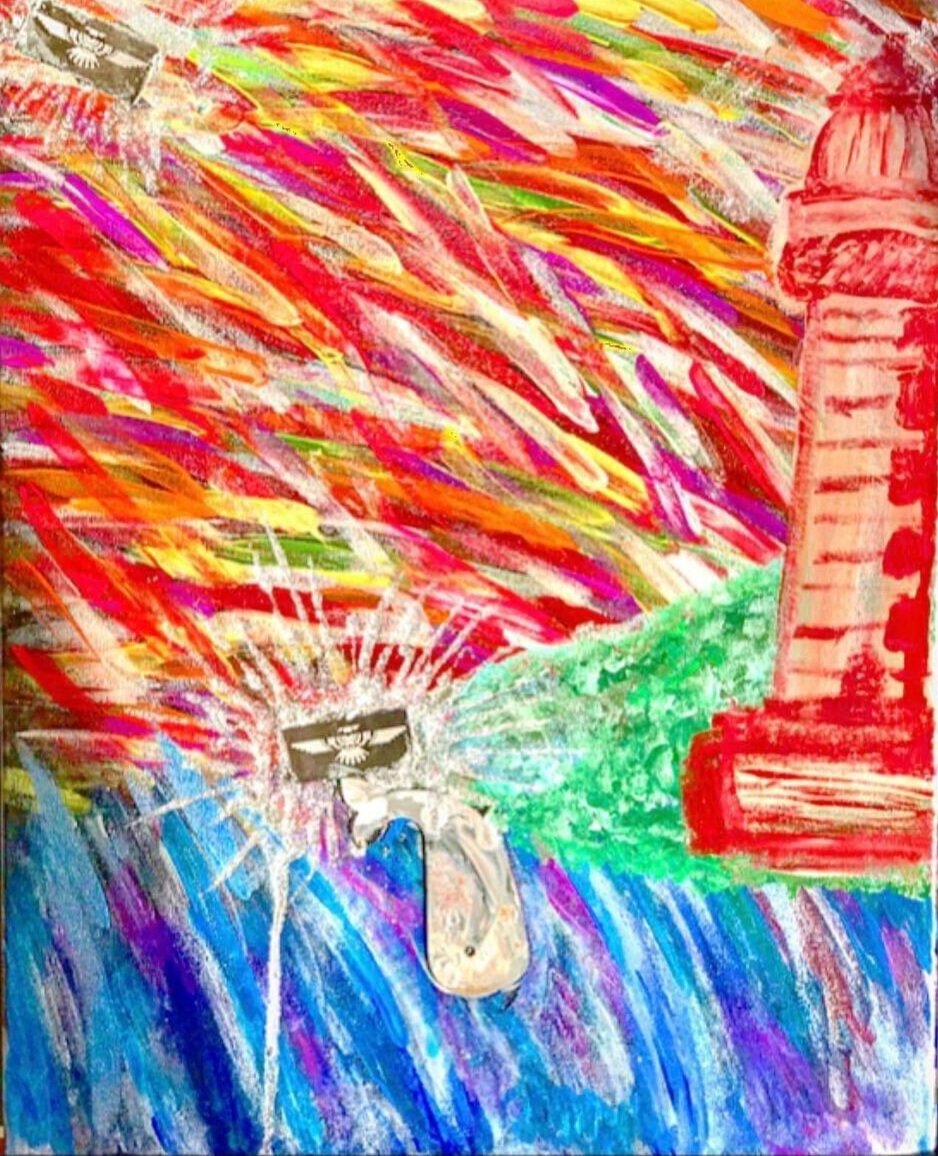
Artwork by Michael Stock
These kinesensic strategies were not new to me. About ten years ago I was physically assaulted. In turn, this Trauma triggered a major mental health crisis. One of the tools I used to heal from that Trauma was Kinesensics, so I was very familiar with using this work to help in a crisis. I detailed my journey in a chapter in the recent Kinesensics book, Play With Purpose; and writing that chapter solidified for me the personal effects of Kinesensics on my body and spirit.
In Covid isolation I made space on my floor to go through Kinesensics progressions: “small-ball rolling” particularly loosened and expanded my ever-increasing psychophysical tightness. I began working on small-scale visual art projects while engaging in the Lessac practice of sighing for pleasure and humming.
Researchers discovered humming alone can lessen the feelings of Trauma and fear. The vibrations produced while humming essentially massage the vagus nerve and deactivate key areas in the brain’s limbic system that neurologically produce the fight, flight, freeze instincts.
The word “breath” comes etymologically from the Greek root of the word “psyche” and the Latin root for “spiritual.” When researching my book chapter for Play with Purpose, I came across this quote from two doctors: “fear is excitement without breath.” This phenomena of excitement without breath leads to all sorts of negative effects on the psyche and spirit. With Covid, I could not physically catch my breath so I was trapped in a state of perpetual fear and panic. As a means to release that fear, I invited more breath through Kinesensics. Sighing for pleasure and humming became my two most efficient ways to find excitement in breath without fear. Sighing is one of the most primal actions the brain experiences, and neuroscientists discovered that sighing is controlled by the fewest number of neurons in any human action. Sighing for pleasure is the most basic life-sustaining reflex.
This is how Kinesensics helped me through another Trauma in my life, and has become my most basic life-sustaining practice. As Arthur Lessac wrote, Kinesensics “is the universal potential of every human being… This [work] is about being human.”

Michael Stock, Lessac Kinesensics Practitioner
BIO
Michael Stock is an artist. He is an award-winning author, actor, director, producer, visual artist, teacher, and started his theater and film production company as a high school sophomore thirty years ago.
He began his Lessac Kinesensics journey seven years ago. He worked with all the world’s Lessac Kinesensics Master Teachers as well Phyllis Griffin at The Theatre School at DePaul University. He is a recognized Lessac Kinesensics practitioner, completed teacher training, and recently wrote a book chapter in Play With Purpose detailing his own journey of addressing mental illness, PTSD, and Trauma by using Lessac Kinesensics.
Please check out some of his work at michaelAstock.com or reach him at Michael.Stock@mac.com
Inter-Involvement: Energy for the Holidays
Perhaps this is really what the holidays are all about. There’s often a kind of anticipatory joy in the air during this time of year that puts a spring in the step and makes people more generous toward one another. Maybe someone lets you go first in a check-out line at the store, or a patient and cheery driver stops to allow you to pull out into a busy street. Inter-Involvement Energy is what happens when this sort of desire to do good for others meets your personal interactions.
By Dana Smith, Ph.D

Here at the Lessac Training and Research Institute, we understand that for many people, 2020 has long ago worn out its welcome. With the winter holiday season here, we long to celebrate with friends and loved ones, often after months or even years apart. Of course, this year the usual gatherings with family and friends will be quite different due to the pandemic. It’s likely that our enjoyment of the season will be directly affected by the degree to which we can adjust to masks, hand-sanitizer, social distance, teleconferencing technology, and the absence of loved ones who prefer not to take any chances.
If you’re looking for ways to find delight in the season during challenging times, Lessac Kinesensics offers a number of tools that can help (the Body Energies, pleasure-smelling, and the YBuzz, to name a few), even if your interactions with people you care about are done via Zoom this year. One of the most effective resources we have is what Arthur Lessac calls, “Inter-Involvement Energy,” which is what you feel when your whole being desires to connect with the person(s) in front of you.
Like the Body Energies of Lessac Kinesensics, Inter-Involvement Energy has nothing to do with anything negative. “Its purpose,” according to Arthur Lessac and Deb Kinghorn, “is to connect you in a positive manner with other living beings,” and the interactions that result cause changes in the human body that are felt in a number of ways (The Essential Lessac 101). We might feel this energy deeply as an emotional response or as a driving impulse to have a calm and rational discussion with someone whose opinions differ from our own. For Master Teacher Crystal Robbins, Inter-Involvement Energy “is to notice within myself where gratitude lies for the conversation. If my family members feel differently than I do about a given subject, do I take the time to have awareness within me that trust is involved on their end to share how they feel? I can then honor that by really hearing it, being the kind of listener that I would want them to be for me. I then am starting my response from a different, non-reactionary place, a place more concerned with the deep desire of sharing.”

The key to tapping into Inter-Involvement Energy begins and ends with the desire to connect with someone. When you’re focused on and committed to involving yourself with another human being, any obstacles that appear can recede to the background; instead of forcing solutions, Inter-Involvement Energy empowers the interaction. As Lessac notes, Inter-Involvement Energy can be such an intense experience, “the emotional experiencing system, in synergic cooperation with the body’s communicating systems, appears to take charge with such vigor that it bypasses the muscular system and all consciousness of kinesthetic exertion” (Body Wisdom 56). All thoughts of effort fade into listening and hearing with one’s whole heart, for the goal is connection. Time flies, because your bodymind is fully entertained with both the process and product of the communication.
Perhaps this is really what the holidays are all about. There’s often a kind of anticipatory joy in the air during this time of year that puts a spring in the step and makes people more generous toward one another. Maybe someone lets you go first in a check-out line at the store, or a patient and cheery driver stops to allow you to pull out into a busy street. Inter-Involvement Energy is what happens when this sort of desire to do good for others meets your personal interactions. Consider how our daily lives might be different, were we to engage in Inter-Involvement Energy every day of the year! That sentiment is expressed in the lyrics to a song called, “The Secret of Christmas,” by Jimmy Van Heusen and Sammy Cahn:
“It’s not the glow you feel when snow appears.
It’s not the Christmas card you’ve sent for years,
Not the joyful sound when sleigh bells ring
Or the merry songs children sing.
The little gift you send on Christmas Day
Will not bring back the friend you turned away.
The secret of Christmas…
It’s not the things you do…
at Christmastime,
But the Christmas things you do…
all year through.”
Whatever holiday you celebrate at this time of year, we at the LTRI wish you the gift of Inter-Involvement Energy that can penetrate all your interactions to make you and those around you feel loving and beloved. Happy Holidays!

Dana Smith, Ph.D.
Newsletter Editor, LTRI, Lessac Certified Trainer
Professor, Truman State University

Sharing to Heal: Connecting with Kinesensics
Near the end of a Town Hall meeting on the Black Lives Matter movement and how the LTRI trainers will change their pedagogy to be more inclusive, diverse, and equitable, Monica Angrand stopped my breath for a moment. She shared in her US Southern dialect how the Lessac work was healing her from trauma she experienced as a biracial person living in the American South. Moreover, she continues to heal her trauma now that she lives in South Africa.
“It’s time to talk about these things. I’m definitely outside of the outside. There’s gotta be someone else who might benefit from [our conversation] as well.”
Sharing to Heal: Connecting with Kinesensics
By Melissa Hurt, Ph.D,
In collaboration with Monica Angrand

Near the end of a Town Hall meeting on the Black Lives Matter movement and how the LTRI trainers will change their pedagogy to be more inclusive, diverse, and equitable, Monica Angrand stopped my breath for a moment. She shared in her US Southern dialect how the Lessac work was healing her from trauma she experienced as a biracial person living in the American South. Moreover, she continues to heal her trauma now that she lives in South Africa.
Being from the American South myself, I felt a strong urge to meet her and learn her story. I moved to Richmond, Virginia when I was ten years old and saw firsthand how African Americans and biracial people were discriminated against in town and in my classrooms. I saw teachers degrade African American classmates in front of their peers and how powerless and misunderstood they felt. As a young child in Central and Southern Florida, I witnessed Othering of my Puerto Rican and Cuban classmates through separate programs in school assemblies in which they were clustered into one group dancing to Gloria Estefan & The Miami Sound Machine and denied presence on stage with the activities of their white peers. Later, I witnessed countless acts of racism against my African American friends, classmates, and community in Richmond. My peers were ridiculed for hairstyles, large earrings, and speaking in African-American Vernacular English. I wondered if Monica experienced events similar to what I witnessed and was fascinated with how the Lessac work contributed to her healing process. I asked her if we could meet over Zoom so she could share her story with me and we could get to know each other. I am so thankful she agreed.[1]
“It’s time to talk about these things. I’m definitely outside of the outside. There’s gotta be someone else who might benefit from [our conversation] as well.”
Monica grew up in Little Rock, Arkansas from the ages 5-20. She was in a school system in which she experienced racism from her peers and her teachers: “When I would get bullied a lot of teachers would let it happen and say it was my fault...these were white and Black teachers.” Monica attended a Montessori school for her early education then transferred to public school in the third grade. She was advanced in her learning and denied an opportunity to answer questions in class because her teachers felt she was seeking attention over other students. In truth, she was an eager learner. However, as a result of her teachers telling her to stop raising her hand, she established a mistrust of teachers. Monica was bullied in school for not being Black enough or not being white enough. None of her teachers protected her. She did not feel she fit in anywhere.
Monica felt she stood out of whatever group she was in. The Black Lives Matter movement was nowhere close to existing. This powerful movement is a call to action to recognize anti-Black racism in communities and by the police. It has been raising social consciousness since its inception in 2016. “In America, the mixed-race person is still the Other. You’ve got the Black Lives Matter and then there’s everybody else. Everyone has their place in society. The mixed-race people have no place and no one wants to deal with us unless we are a token friend. You’re either not white enough or you’re not really Black enough so step back because we’re going to have a real discussion now and you can’t be here.”
She moved to Los Angeles to be an actress, decided to go back to college, and studied at Santa Monica College. Her first impression of the Lessac work came from her teacher, a Lessac certified trainer, who shared genuine warmth, care, and thorough knowledge of her teaching practices. Her teacher taught from a lived state of Buoyancy energy and incorporated the Personal Uniqueness Principle, which recognizes the individual as ever-changing throughout the bodymind and voice. This caring teacher applied this principle with all of her students whether the student naturally adapted to the voice and movement work or struggled with it. Monica felt she could trust this teacher and what she taught fully because she did not Other her or make her feel incompetent as she learned. She shares, “We bonded instantly. I think a lot of that bonding helped to validate the work because coming from a place personally where I don’t trust a lot of teachers...because she was so kind and non-judgmental...it made me trust the work because I trusted her. It’s her that made me trust the work was positive.”
Monica first explored Lessac kinesensic body work in a one-week intensive in Indiana, where she experienced much of the voice and movement work, including those a teacher may not have time to include in a college curriculum over the course of one semester, such as “small ball rolling” or “shoulder rolls”. The intensive gave Monica the focused time and space to realize the synergy of the voice and movement work. It wasn’t until later that parts of the Lessac work helped Monica begin to heal her trauma.
Monica moved to South Africa in August 2019 with a work Visa for acting. She makes breathing consciously a regular practice as she re-builds her life in South Africa, which she calls “paradise”. Exhaling via Lessac’s Pleasure Sighing in a moment of a traumatic memory based on racial Othering helps ground her in her present experience in South Africa. Sighing rebalances the neurological state by releasing fear. Monica consciously sighs whenever she feels the muscular and emotional tension that arises in a triggering moment to neurologically balance her bodymind and connect with the actual moment.

The inherent nature of Buoyancy energy is that of sighing through the whole body, fueled by the breath, and sustaining senses of floating and grounding at once. Buoyancy energy made an impression on Monica because of its qualities of weightlessness and ease, which are feelings she rarely feels in her daily life with the exception of swimming. Buoyancy energy makes Monica recall the feeling of being in a swimming pool, which is a wonderful sensation because she has been a swimmer her entire life. As a swimmer myself, I instantly knew what she meant. There is a feeling of relief when a swimmer enters the water and starts moving in the rhythmic pattern of a swim stroke with the breath. This feeling of home in the water affects the body with ease, calm, and focus. These sensations become familiar events for feeling Buoyancy energy out of the water to consciously initiate feelings of wellness in any situation. The Buoyancy sensation is often associated with feelings of relaxation, centeredness, hope, calm, peace, serenity, total awareness and connection with the inner world (Lessac and Kinghorn 2014: 39). Monica wants to inhabit Buoyancy energy more fully in her daily life to counter the tension lodged in her body based on the traumas she encountered daily in the United States. Monica feels Buoyancy is the most beautiful sensation.
Monica continues to explore Lessac Kinesensics to aid in her healing of racial Othering. It is a daily process that will take patience and time to navigate. The combination of Lessac work with making South Africa her new home has given her foundational tools she needs to feel well and remain present in her daily interactions with people from all backgrounds. Monica and I both hope that sharing our experiences with Lessac Kinesensics shows its value not only as a tool for personal expression and actor training, but also as key in emotional healing and well-being. The takeaway for Lessac certified trainers is to truly, whole-heartedly model the foundational principles of the work as we work with all students honoring their Personal Uniqueness.

Melissa Hurt, Ph.D
Melissa Hurt is a Lessac Certified Trainer and author of Arthur Lessac’s Embodied Actor Training. She teaches voice, yoga and movement and is the owner of Integrative Studio
Works Cited
Angrand, Monica. Interview on Zoom. July 10, 2020.
--- ---. Interview on Zoom. July 14, 2020.
Lessac, Arthur and Deborah Kinghorn. Essential Lessac: Honoring the Familiar in Body, Mind, Spirit. Barrington, NH: RMJ Donald, 2014.
Munro, Marth. “Mapping Lessac Kinesensics” in Play with Purpose: Lessac Kinesensics in Action, eds. Marth Munro, Sean Turner, and Allan Munro. New York: LTRI, 2017.

Buoyancy and Emotion Regulation
Buoyancy Energy is in our muscle memory—it’s that set of familiar sensations you feel when floating: a weightless, effortless ease. You can feel it in a body of water, after a great massage, walking in mist or a lovely snowfall, or perhaps you’ve had the experience of receiving wonderful news that causes you to feel like you’re floating on air. When buoyant, your body feels relaxed and oxygen-charged, so that your movements are smooth, easy, and fluid.
Buoyancy and Emotion Regulation
by Dana Smith, Ph.D.

The ability to regulate your own emotions is one of the defining characteristics of emotional intelligence. In today’s world of pandemic, social upheaval, political division, and struggles with mental health, emotional intelligence is perhaps more important than ever. Neuroscientific laboratory experiments conducted during the past thirty years have proven that some degree of emotion regulation is possible through consciously employed physical strategies. A growing amount of evidence suggests that if you can assume the breathing pattern, facial expression, and body attitude of a desired emotion (the Emotional Effector Patterns), you can actually begin to feel that emotion.
For the past seven years, I’ve been researching Lessac Body Energies for their potential in regulating emotion. Those of us who practice Lessac Kinesensics can testify that this work offers many powerful tools for coping with the stresses of the day, and one of the most effective tools is Buoyancy Energy. Buoyancy is one of the four natural human body climates in Lessac work, which may be harnessed at any time to enhance any human activity.
Buoyancy Energy is in our muscle memory—it’s that set of familiar sensations you feel when floating: a weightless, effortless ease. You can feel it in a body of water, after a great massage, walking in mist or a lovely snowfall, or perhaps you’ve had the experience of receiving wonderful news that causes you to feel like you’re floating on air. When buoyant, your body feels relaxed and oxygen-charged, so that your movements are smooth, easy, and fluid.
Buoyancy Energy can calm the spirit and promote a feeling of well-being. There’s a physiological reason for that. Explorations in Buoyancy can inspire some elements of an Emotional Effector Pattern, one of six core emotions identified by Chilean neuroscientists in the 1970s. Although feelings are highly subjective and words are insufficient, the general category of emotion I experience most often when working in Buoyancy is the feeling of tenderness or tender love. Others have called it: serenity, affection, peace, and calm contentment. Whatever you call it, this emotion (like the other five core emotions) can be induced through physical means.

I’ve observed that the Emotional Effector Pattern for tender love happens naturally when I move my body buoyantly, as if I were floating. In this pattern, breathing is through the nose. The exhalation is just a beat or count longer than the inhalation. After you exhale, there’s a slight pause or rest before the next inhale begins. Laboratory studies have proven that this breathing pattern lowers the heart rate, blood pressure, and other physiological markers, as well as slowing the release of stress hormones.
One Buoyancy exploration we frequently turn to in Lessac work is called, “wafting and waving”; while standing with shoulder-distance between your feet, you allow your torso to slide (waft) right and left and back again, over and over, in an easy flowing rhythm. Shoulders and hips move together, side to side. This action encourages the tilting of the head to one side—another element of the Effector Pattern for tenderness. You can enhance the experience of wafting and waving into tender love by relaxing your face into a closed-mouth smile, as tiny facial muscles around the mouth and eyes yawn toward the ears. The muscles in the cheeks also move up and back. A final conscious adjustment would involve the slight curling of the rib cage with the head tilt. The whole body is relaxed and open.
Emotion regulation doesn’t mean that you shouldn’t feel what you feel; there is a rightful place for all emotions in our lives. But if you find yourself getting stuck in an unwanted emotion, and are looking for ways to cope, Buoyancy Energy offers a way through. In Essential Lessac, Master Teacher Deb Kinghorn proposes something she calls, “love energy”: “the pervasive sensation of well-being so thoroughly fills experience that it becomes a concrete physical sensation, perhaps not unlike flow or being in the zone.” To me, this sounds like Buoyancy, coupled with the Emotional Effector Pattern for tenderness or tender love.
The world can be a scary place. We pay a price for holding onto conflict and tension, and the cost is to the human bodymind. Feeling anxious? Stuck in traffic or in a long and slowly moving line at the end of the day? Or do you find yourself exhausted by people who are stressed and angry? I recommend a little Buoyancy.

Dana Smith, Ph.D.
Newsletter Editor, LTRI, Lessac Certified Trainer
Professor, Chair of Theatre, Truman State University

Starting Here: Finding Inner Strength in an Outer Turbulent World
Starting Here: Finding Inner Strength in an Outer Turbulent World
By Kathleen Dunn-Muzingo

Actor and Lessac Student Priyank Thakkar
After teaching online during a pandemic, witnessing the brutal murder of George Floyd via shared media, through the burgeoning and painful awakening of my white privilege, I feel lost and inept. Lately, I have been drawing inspiration from Arthur Lessac’s holistic body training where he addresses the inner environment versus outer environment in his book: Body Wisdom, the Use and Training of the Human Body. I find the Lessac Body Voice concepts guide my everchanging world of personal awareness of injustice, equality, and diversity with my students. I want to extend a virtual hug to the Lessac Master Teachers and LTRI members for their time and support these past few months. So, in gratitude I share one of my class explorations in Lessac Body Voice work.
As I claim my personal creative space at home, I discover that negotiating space outside myself symbolizes how my students are influenced by outer environments of hate, brutality, judgment, self-deprecation, environmental pollutants, and COVID-19, all which suffocate our inner environment where creativity and voice are born.
To see myself in my students’ eyes, I remind myself what it was like growing up (a victim of school bullying) and how it was difficult to negotiate my power and my space. So, I start with telling my personal story about negotiating personal space and finding my voice. I invite others to do the same if they wish, acknowledging that my experiences pale when compared to the injustices of systemic racism and outward violence.
DAY ONE—OUTER ENVIRONMENT VERSUS INNER ENVIRONMENT: Exploration One

Kathleen Dunn-Muzingo (right) works with student actor Ky Snider (left)
Working with the outer environment and looking around their rooms, large or small, I encourage their eyes to land on something they appreciate or want more of—could be more sunlight, or a photo of a loved one, a stuffed animal, unique to them. I ask them to spend time in appreciation with that object or presence. I invite them to notice how they feel inside, physically. What are the sensations of appreciation or pleasure? That of lightness—of calm—of noticing breath. Students are encouraged to explore the connection between the outer object and their breath. Perhaps one will notice that the breath has slowed, while others may become aware of physical tensions releasing and softening the face. Giving space to the sensing-feeling process and discovering how the outer environment can influence one’s inner environment is the first step in awareness of outer environmental influencers and their impact on our health and our breath. We discuss some of those outer-environmental influences that stifle breath, but also acknowledge that through exploration we have a choice of the quality of breath within ourselves. We can cultivate our own centered breath and physical presence. I ask some to share their objects and this becomes their favorite thing to do. As we finish, I drop in little seeds of awareness in appreciating our breathing after having done this exploration, perhaps noting new areas and spaces in the body that seem to have released or opened. For next class, we are encouraged to bring something we love to smell or taste. We will spend time with these objects or foods, exploring the path an embodied breath takes through pleasure smelling and experiencing that pleasurable sigh of relief afterwards which becomes a template for one’s free responsive breath.
CREATING THE FREEDOM WITHIN YOUR SPACE: Exploration Two
Now that we are mindful of our breath, we go on a journey in discovering the various levels the body moves through space during one’s daily life. First, they find a space where they can lie down, and they are encouraged to take time to move their computers to the level where they can be seen. Once on the floor, we stay there, allowing the breath to flow into the body and out as the waves of the ocean, a cool breeze, or just silent awareness of the natural movement of breath in and out, without manipulating. Then the students are guided to move slowly into the fallen leaf, then into a crouch, and then travel up the spine to standing. Moment to moment guiding, which is not detailed here, is what is taking place as I see each student via Zoom.
In each dynamic level from lying down to crouched to floating up the spine, we are negotiating our space, allowing breath awareness to move our backs and our sides, allowing that breath to buoyantly float us up through our spine. Our spine is our strength. Here the students explore this journey on their own from floor to standing. This can be the first step in finding their space, their right to take up space, to feel a centered confidence, and an ease of one’s own breath. In the many intensives with Arthur, I fondly remember him saying “So as we breathe, so as we stand, and vice versa,” and standing in our space is a matter of being seen and allowing ourselves to take in a full, rightful, deeply-supported breath that allows our voices to be heard.
We wrap with a discussion and students note the power in awareness of physical sensations that support health, well being, and self worth. The work still reaches through the internet.
Kathleen Dunn-Muzingo is a Lessac Certified Trainer and Associate Professor of Performance and Voice & Movement Studies at the University of Southern California School of Dramatic Arts

Updates from the LTRI Executive Committee!
The Executive Committee members (President—Daisy Folsom, President Elect—Kellynn Meeks, Past President—Steve Housley and Managing Director—Sean Turner) cherish collaboration. We are a team. We send you well wishes and exhilarating news.
Executive committee Updates
The Executive Committee members (President—Daisy Folsom, President Elect—Kellynn Meeks, Past President—Steve Housley and Managing Director—Sean Turner) cherish collaboration. We are a team. We send you well wishes and exhilarating news.
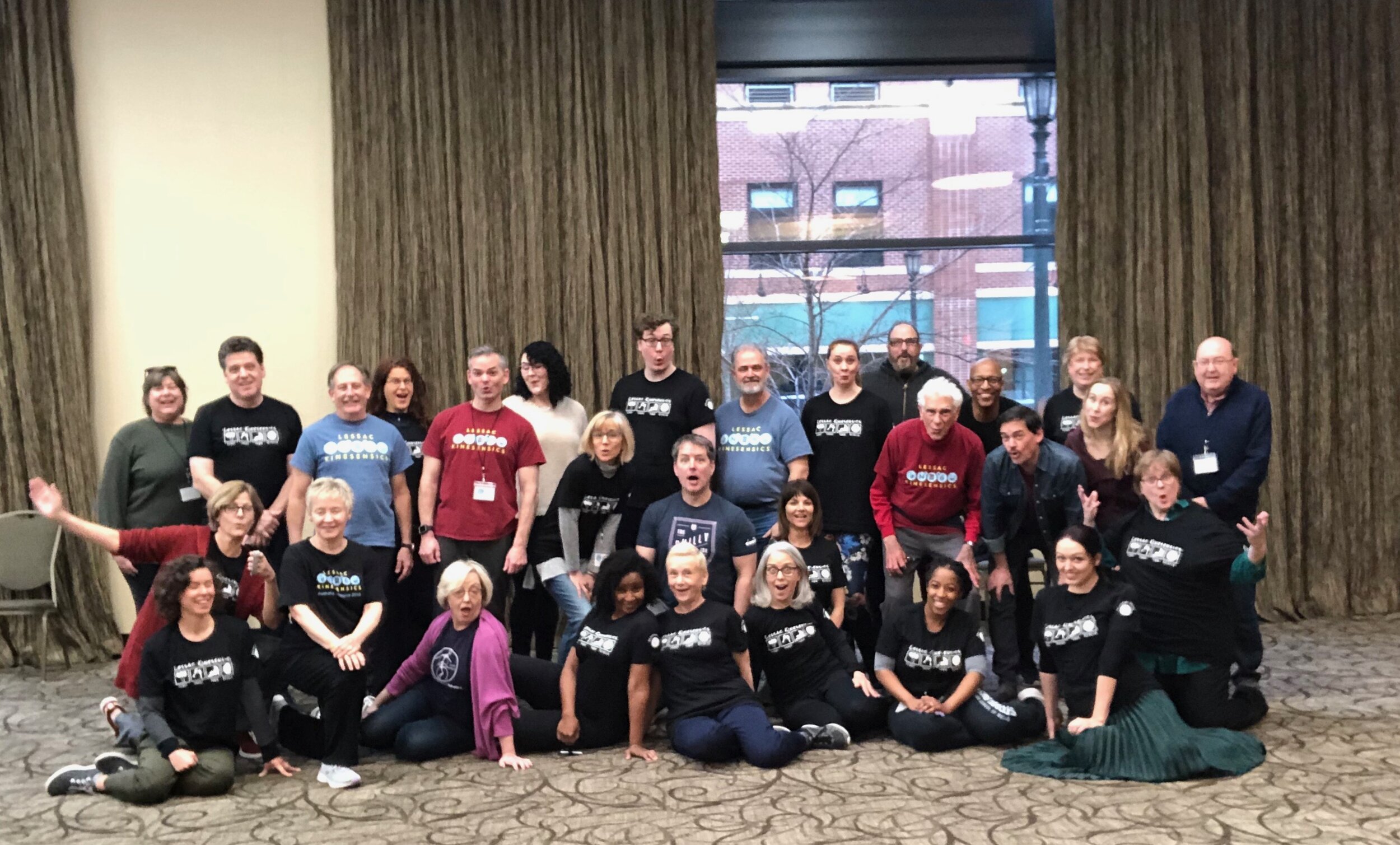
2020 International Conference Participants at Kent State, January 11, 2020
The Lessac Training and Research Institute's International Conference at Kent State (2020) was an enormous success. We congratulate the esteemed Courtney Brown—On-Site Coordinator and the gracious Crystal Robbins—Master Teacher Conference Representative for giving their time and energy to make the conference a most memorable and inspirational experience. Thanks to all of the participants for your contagious enthusiasm. Lastly, thank you to each presenter for creating and sharing thought provoking work. We look forward to seeing everyone and meeting new friends and colleagues at the 2022 conference in Los Angeles, California. Keep your eyes on future newsletters for more information about the West Coast conference.
Awards and New Training Designations

Robin Aronson
2020 Lessac Institute Leadership Award

Dick Cuyler
Lifetime Membership
AWARDS
The LTRI wholeheartedly congratulates Robin Aronson for receiving the 2020 Lessac Institute Leadership Award and Master Teacher, Dick Cuyler, honored with a Lifetime Membership at the conference.
Congratulations to our new Trainers
Certified Trainers


Practitioners
2018 Intensive DePauw University, Greencastle Indiana: Stephen Crandall, Marilene Grama, Penny Larkins, and Kevin Shell
2018 Intensive NIDA Australia: Gavin Leahy and Robert Maxwell
2019 South Africa Intensive: Lizanne Schultz
2019 MFA Program University of Southern Mississippi: Jon Andrew, Melissa Angelo, Emma Harr, Lauren Gunn, and Jonathan Swindle
2019 Intensive DePauw University Greencastle, Indiana: Martina Biljan, Mannette Antill Cogan, Serena Lockhart, Mark Mocarski, Laura Resinger, and Claudia Wier
2019 Intensive NIDA Australia: Abigail Cathart, Syaiful Ariffin bin Abdul Rahman, Angela Sullen, and Yuanlei Nikki Zhao
Upcoming Intensives…please help get the word out!!!

June 21-July 17, 2020 Depauw University Greencastle, Indiana

August 2-22, 2020 National Institute of Dramatic Arts (NIDA) Kensington, New South Wales

January 2021 3-week Program University of Pretoria South Africa


Recent Publications
Two dynamic new books published by The Lessac Training and Research Institute ® (2020) are now for sale on Amazon.
Body Wisdom: The Use and Training of the Human BodyAuthor: Arthur Lessac with a new introduction by Deborah Kinghorn
Collective Writings on the Lessac Voice and Body Work: Festchrift Editors: Kathleen Campbell, Allan Murnro, Marth Murnro, and Sean Turner
A Final Note
It is delightful knowing that membership is growing. We are all enriched by each member’s unique contributions to the Institute. Thank you for joining and/or renewing your membership and thank you to Aimee Blessing—Membership Director and the entire the membership team.
The Executive Team wishes everyone a most radiant time as we continue to celebrate collaboration and community.
Kindest Regards,
The Executive Committee Members
Daisy Folsom, President
Kellynn Meeks, President Elect
Steve Housley, Past President
Sean Turner, Managing Director

LTRI Announces its 2020 U.S. Intensive Faculty
The Lessac Training and Research Institute is pleased to announce the faculty for this year’s Lessac Summer Intensive Workshop: Master Teacher Crystal Robbins from Santa Monica, CA and Master Teacher Marth Munro from South Africa. These gifted instructors will bring decades of experience and training to this workshop, which will be held in a retreat-like setting at DePauw University in Greencastle, IN, from June 21-July 17, 2020.
Meet the Faculty for the 2020 Lessac U.s. Intensive Workshop!
The Lessac Training and Research Institute is pleased to announce the faculty for this year’s Lessac Summer Intensive Workshop: Master Teacher Crystal Robbins from Santa Monica, CA and Master Teacher Marth Munro from South Africa. These gifted instructors will bring decades of experience and training to this workshop, which will be held in a retreat-like setting at DePauw University in Greencastle, IN, from June 21-July 17, 2020.
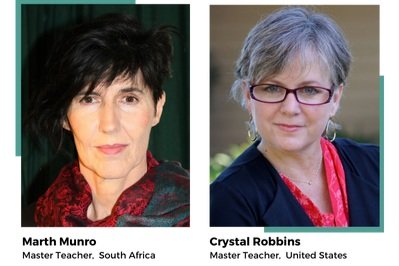
Crystal Robbins and Arthur Lessac in 2000
Crystal Robbins worked and trained closely with Arthur Lessac for the last 13 years of his life, which taught her that “entry into the work can start from anywhere,” and “there’s always more than one way to do things!” She has taught Lessac Kinesensics for over two decades at university and K-12 institutions, as well as in numerous workshops and intensives. She has been a private acting coach for 25 years, with an extensive background as a professional performer. Crystal finds applications of Kinesensic work “every day and in every way,” and currently is investigating medical applications involving the kind of balance we find in Lessac’s “wheel walking.” Crystal has been active in the LTRI, twice serving on the Board of Directors, and on various committees that support the work of the Institute.

Marth Munro (left) leads students through a physical exploration of Buoyancy in Croatia.
Marth Munro, PhD, is a Professor extraordinaire at the University of Pretoria, South Africa, and also is associated with the Wits Business School. Her research and training has focused on understanding how the “body, brain, emotion, and voice interact creatively,” and her work as a teacher is guided by a belief in embodied and experiential learning that honors and accesses the uniqueness of each student as a human being. In addition to being a Master Teacher of Lessac Kinesensics, Marth is also a certified Laban/Bartenieff Movement Analyst, a Certified Sound Therapist, a qualified Hatha Yoga teacher, and has expertise in Bio-and-Neurofeedback. Above all, Marth finds that Lessac work allows her to “play with a childlike curiosity.”
About the Intensive Workshop
You will find opportunities all over the US and the world for learning Lessac Kinesensics, but perhaps the backbone of the Lessac Institute’s offerings is the Intensive Workshop. Although conditions may vary, most of these intensives are conducted in retreat-like settings over three to four weeks so that participants can immerse themselves fully in the process of learning.
The U.S. Lessac Intensive is a four-week workshop. During the first two weeks, students learn about the origins and foundations of Lessac Kinesensics through experiential voice and body work. The last two weeks are devoted to actively applying the work to specific texts, tasks, and contexts. Each day of the intensive starts with body work, followed by large-and-small group voice classes. Participants are given several hours of free time to lunch, rest, meet with their assigned buddies for assignments, and private coaching. The day ends with a second small group class.
Crystal Robbins (front, second left) with the 2019 U.S. Summer Intensive Participants.
The Intensive is so named for a reason; the days are full and much material is covered. But the evenings are free and the Greencastle community offers many restaurants, parks, and pretty places to bond with your peers and absorb the material in conversations about the events of the day. The Intensive experience tends to produce lasting effects and friendships. As Crystal notes, “There is nothing quite like the intensive immersion experience. It will surpass your expectations, as you take a deep dive into the relationship between your body and voice. Be prepared for a transformative and joyful ride that builds on your strengths and offers you strengths you didn’t know you had.”
For more information about the Summer Intensive at DePauw University email us at: info@lessacinstitute.org or click blow.

SPOTLIGHT: An Interview with Deb Kinghorn
Deb Kinghorn is a Master Teacher of Lessac Kinesensics, and Professor in the Theatre and Dance Department at the University of New Hampshire. She worked closely with Arthur Lessac over several decades, and most especially during his final years, when she co-authored, Essential Lessac, with him. She teaches Lessac work internationally and stays active as an actor, director, and voice and dialect coach. (Read more)
SPOTLIGHT: An Interview with Deb Kinghorn
Deb Kinghorn is a Master Teacher of Lessac Kinesensics, and Professor in the Theatre and Dance Department at the University of New Hampshire. She worked closely with Arthur Lessac over several decades, and most especially during his final years, when she co-authored, Essential Lessac, with him. She teaches Lessac work internationally and stays active as an actor, director, and voice and dialect coach.

Deb Kinghorn and Arthur Lessac 2009
How did you first get involved with Lessac Kinesensics? What first piqued your interest?
I first learned of Lessac work in 1973 at the State University of New York, Fredonia. My teachers had just attended an 8-week workshop and began teaching the work in our classes. I immediately fell in love with it. I had been doing another kind of vocal training that involved mostly rote repetition and imitation, and when I began learning Lessac work, I was full of wonder at how imaginative it was. I also studied voice in England—some completely different systems there, and then in graduate school, the program interwove Lessac and Linklater work into their training.
Then I began working as a professor, teaching classes, and realized very soon that I didn’t know enough. So I attended my first Lessac intensive in 1984, ten years after I was first introduced to the work. I saw a flier, got a scholarship, and attended the 6-week workshop. I was in nirvana! I knew the vocal work pretty well, but the body work was a revelation. I thought, oh, my God, how could I ever have taught without this! So there were two “AHA!” moments—the introduction in 1973 and the reintroduction in 1984, when I met Arthur.
Arthur and I completely hit it off. In the way we talked and thought about things, our energies complemented each other. It was so easy to talk to him. The next year Arthur asked me to teach a workshop with him, which was for nominees of the Irene Ryan Acting Competition, part of what was known then as ACTF (the American College Theatre Festival). The workshop was six days long, and I took over for Arthur after the first three days. It was during those first three days that we discussed the many different applications of the work. I was too young at the time to realize what they could mean. But there were cross-cultural applications, health and wellness applications, and so many others…it was fascinating to see how Arthur pulled so many aspects of life and living together into the work. It all intrigued him. I listened, but it didn’t really click until later, as I was just interested in the teaching aspect.
What stories stand out in your mind about working with Arthur Lessac?
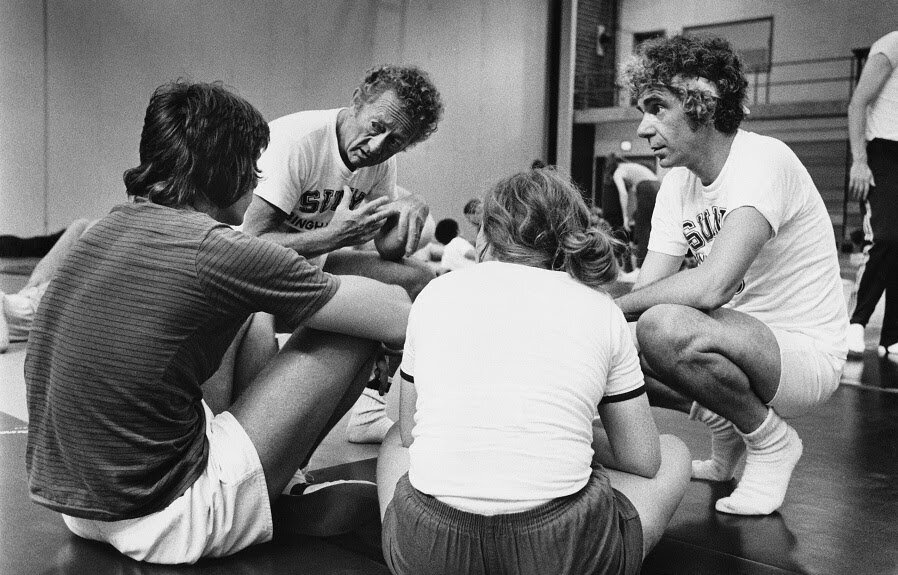
He was so vital, so full of life, so full of energy, and he was extremely thoughtful. He was also a very smart man. He was always a courageous man, although he didn’t think of himself that way—he was willing to go the distance to fight for what he believed in, and always allowed people to be themselves within his voice and body work.
He was passionate about the work and its efficacy. Around 2007, we had a long conversation that was a memorable one for me, about 5 hours, concerning his research. He wanted very much for people to do more to expand his work—he always felt like there was more: he’d say, “I wish for the growth of our work.” He called his work “pre-scientific,” and admitted he was not a scientist, but he did a tremendous amount of research. Theatre is a laboratory. He was his own laboratory. He always tested the work on himself, living it, embodying it, using it in every single thing that he did. But I remember that he never looked at himself as a researcher—never connected all of the thousands of hours of classes and experimentation with the work of a researcher, but that’s what he was.
I truly loved Arthur’s willingness to discuss things, to hear all kinds of different ways of working. He wasn’t protective about the work. He was very clear about it and would listen to anything, believing that healthy disagreements were okay. But in the end, he would ask, “Is it organic? How does this exploration compare or contrast?” And he would always go back to honoring the organic principles of the work.
How has Lessac work evolved over the years?

The work has evolved in terms of being more open, less rigid. During the last weeks of his life, Arthur wanted to make sure the work would evolve, and not just for actors. That always stayed with me—don’t let the work stagnate. He gave everyone that gift. He’d say, “You have the creative potential, the bones, whatever, to go further.” His amazing generosity is what I’ll remember. He always talked about kinesensics as our work. The teacher/student relationship has changed. That is a significant evolution of the work—you, the student, are in charge. I am a guide. You tune in to what this feels like in you. Give it your own name, if you wish. You own it. Arthur felt that any evolution must cut across cultures. It comes back to being a human being, subject to gravity. As the work evolves slowly over time, in my teaching, I ask myself, can I take one step back? Am I parroting what I have learned from someone else or is there a previous step that I’m leaving out? We benefit from looking both backward and forward.
Teaching this work involves so much more than a syllabus. I see people embracing the holistic nature of the work as they recognize that individuals matter. That’s another way that the work has evolved—the pedagogy and how we address one another, becoming more and more inclusive in our teaching. Whether we’re in Brazil, South Africa, or Croatia, Lessac work is respectful of cultural identity.
Take something fundamental to kinesensic work: the y-buzz. This involves using a phoneme that doesn’t exist in many languages (the Y consonant), but if you can find the comparable sound in the other language, you can get the same feeling, which is central to our work: the feeling modality, and from that you can teach (a differently named version of) the y-buzz. In other vocal training you hear a lot about the “placement” of sound in the mask area. Do all languages do that? It’s a big question in voice communities—is that a Western concept that’s not necessarily true for all languages? With placement, or any single concept, the terms don’t seem to apply across cultures. But when sound is produced on the vocal folds, vibrations occur in the bones of the head, while placement differs. But the human truth is that bones vibrate—that’s the bottom line, inescapable.
The voice is so much more than resonance and articulation. Arthur’s work has to do with the development of the whole human being. There was a point in time when the idea of the individual Voice became clear in my mind. The Voice becomes the manifestation of all that we are, and can have a significant impact on the world around us. We may begin with the Consonant Orchestra, yes, but the Voice evolves as we experience ourselves, our individuality, and our humanness. On a microscopic level, atom-to-atom, a Lessac trainer plants a seed and lets it grow. Our job as trainers is to nurture those seeds in each other. That’s the legacy that Arthur wanted us to pass on. We are responsible for the fruitfulness of each other. It’s a powerful message that I carry with me always and underscores everything I do for and with the Institute. Seeds don’t grow quickly. Some don’t germinate. The work we do isn’t something we can manufacture or project automatically. But with careful nurturing, if we water growth, we know we’ll see people wanting to be a part of this Institute. They see that they can be themselves with us, and that they have a valuable Voice.
More from this interview with Master Teacher Deb Kinghorn will appear in the Spring/Summer 2020 LTRI Newsletter.

WHEEL WALKING AND RACE WALKING—ONE LEADS TO THE OTHER!
I have always been an avid runner, since my early 20s. But in recent years, I have been investigating other workout options to keep me fit as the proverbial fiddle. It is a known fact that as we age, running long distances can certainly contribute to shin splints, ankle and knee problems, hip issues etc., simply because of the impact that running has on the body. So I have been searching for a way to continue the cardiovascular and toning benefits given by running without the negative impact (pardon the pun). Enter race walking…. (Read more)
WHEEL WALKING AND RACE WALKING—ONE LEADS TO THE OTHER!
By Lessac Master Teacher Nancy Krebs

Nancy Krebs is a Master Teacher of Lessac Kinesensics and has been a professional actor/singer/musician since 1975. She taught with Arthur Lessac beginning back in 1995, and either directed or co-directed the Lessac Summer Intensive Workshops, as well as international intensives for 17 years. She has worked as a vocal/dialect coach for more than 150 professional and university productions in the Baltimore-Washington region since 1994. She recently ‘retired’ after teaching a four-year Lessac-based voice curriculum in the Theatre Department of The Baltimore School for the Arts. She continues to teach, coach and perform on a regular basis.
I have always been an avid runner, since my early 20s. But in recent years, I have been investigating other workout options to keep me fit as the proverbial fiddle. It is a known fact that as we age, running long distances can certainly contribute to shin splints, ankle and knee problems, hip issues etc., simply because of the impact that running has on the body. So I have been searching for a way to continue the cardiovascular and toning benefits given by running without the negative impact (pardon the pun). Enter race walking….
I used to make fun of the rather bizarre gait used by professional race walkers. It was smooth and efficient, but the swaying of the hips looked a little comical to me—and to many others as well. That being said, I would like to share with you as to why race walking now fascinates me, and has captured my attention and my heart only very recently. I have finally recognized the relationship between this sport/exercise and our Kinesensic wheel walking.
Arthur Lessac describes the action of walking (page 180-181 in Body Wisdom) as an exploration of motoring our legs like wheels along with arm loops to maintain a smooth balancing act. One foot always has contact with the ground, rolling from the heel to the toes, where the push off takes place, and the arms help this action along by the swinging forward and back in a looping fashion. The body has a curvo-linear feel/look from the crown of the head to the hollows of the knees. The crown of the head (where the parts come together) rests up as the highest point, not the forehead. When I am teaching the wheel walk in a workshop, participants are always struck by how smooth the gait is, how effortless the forward momentum, even when transitioning from a walk to a jog to an actual run, and into a sprint. That’s because you allow the Lessac Body Energies (NRGs) to work in you as you move. For instance, my upper body, from the waist up, induces a combination of Radiancy with some Potency sprinkled in—and the lower part of the body—from the waist down, has a resting-down Buoyancy feel. Radiancy is a body energy state that feels like electric sparks flying throughout the body, similar to an excited feel when anticipating something positive, so there is some ingredient of muscle shaking. Potency is chemically-charged, taking place in the muscles where there is a feeling of power, extension, release and a ‘muscle-yawning’. Buoyancy is an energy state where the body feels as if it is weightless, floating, and is always ‘fueled’ by oxygen, produced through the act of breathing. When I transition the wheel walk into jogging and then into running and sprinting, the physical strategy doesn’t change; the leg-wheels just roll faster and become larger.
I never really noticed the transition immediately before our ‘walk’ becomes our ‘jog’. This is what I discovered taking place after I began to analyze that isolated moment quite recently: when the leg wheels are in motion as we gain momentum—the hips have to sway from side to side to accommodate the speed without lifting off the surface to become the jog or actual running. This constant contact and rolling motion is actually ‘race walking’. According to the two rules to which race walking adheres—

1. one foot has to have contact with the walking surface at all times, and
2. the advancing leg must be straight, not bent upon that contact until the torso has passed over the advancing leg, i.e. until the advancing leg is in the vertical position.
Aha! We are adhering to both of these ‘rules’ when we perform wheel walking as it was intended.
Additionally, the arm movement of race walking is so similar to our arm loops or the scooping action that we use in our hill climbing, as to be indistinguishable. I was watching various race walking competition videos, and aside from personal preferences; the arm movement was identical in nature to how we use our arms in Lessac body training when either running or rolling up a hill with the arms assisting aerodynamically. Additionally, all the walkers maintained the crown of the head as the highest point, eyes gazing at a distance of about 20 feet in front of them. There was no bouncing, no heel ‘strike’, only a fluid transfer of weight from side to side, accentuated by the sway of the hips, and a curvo-linear look to the entire torso into the hollows of the knees as their feet held a straight line in front of them with minimal space between the left and right leg as they walked.
My own experience with race walking began several weeks ago, when I decided to try it from videos and some basic instruction. I found that it was very easy to perform the action of the walk simply by using wheel walking, and adding a more pronounced arm movement forward and back to accompany the foot work. It was no different, only more focused on maintaining a quicker pace without breaking into an actual run—which takes a lot of attention to detail. It requires a good deal of ‘staying in the moment’ to hold onto the pace, the rhythm, the arm movement, the form of the curvo-linear posture to do this well—but I am reaping the benefits already—even with only five weeks of testing it out on a daily basis. The hip action that accompanies the rolling heel-to-toe footwork creates a twisting movement of the upper torso that exercises its entire circumference. I can feel that action toning all those muscles already, even with just a 30-40 minute walk (roughly 5000 steps) every day. Additionally, the hip movement is working the gluteous maximus much more than in running, so those muscles are really getting toned. My arms are constantly rocking forward and back, much more than when running—so the entire upper body is getting a workout as well as the lower body. I can feel all the muscles of my legs muscle-yawning and getting stronger with each day of training. I would say that this new sport is firming up my entire body—a really good investment considering the only expenditure for me was a new pair of running/walking shoes! I am lengthening my workouts every day, and hope to find a coach in the near future to give me additional tips on style and speed. I’ll give you an update in a few months on my progress—I may even enter a race at some point.
I would strongly encourage anyone who wants to adopt a new workout routine with minimal investment; reap the many benefits of this sport for improved health, weight loss and well-being—to give race walking a try. If you know how to ‘wheel walk’, you already know how to ‘race walk’. One leads to the other easily and organically. So get out there and wheel-race-walk!

ON POTENCY
Potency is a high-voltage muscle stretch (like the yawning cat) that vitalizes the body with a sense of robustness and strength. It relaxes as it empowers, creating optimal efficiency in the body-mind. Next, you might instinctively begin to stretch throughout your body, much like the full body movement a cat indulges in when it wakes up from sleep. (Read more)

Next time you have to sit for an extended period of time like driving or flying, notice what happens once you’re able to get up and move. At first, you might be aware of how stiff your muscles are. Next, you might instinctively begin to stretch throughout your body, much like the full body movement a cat indulges in when it wakes up from sleep. Perhaps you want to reach further and further. Notice how good it feels, and how the body feels refreshed and energized. Or picture you’re on a swing, and every pull through your hands and stretch through your legs swings you higher and higher. That power you can generate on a swing, that jolt of freshness and energy after stretching through your entire body, this is the feel of Potency Energy!
Potency is a high-voltage muscle stretch (like the yawning cat) that vitalizes the body with a sense of robustness and strength. It relaxes as it empowers, creating optimal efficiency in the body-mind. It is power without pain and relief without strain. To engage with Potency, try this: stand in front of a wall or closed door, place your hands on the surface and lean in and then push yourself away from the wall. Do this several times to feel the sensation of it. Now, repeat the first step, but muscle-yawn, or engage your entire back, between your shoulder blades, and along your spine before you push away from the wall. As you engage or muscle-yawn, you will feel that your body wants to move away from the surface on which you are leaning, you may feel as if your back is leading the movement, and your arms will have to work less. Your abdominal area is slightly concaved, while your back is rounded. Notice if muscle-yawning away from the wall or door feels easier and more efficient than just pushing away with your arms. When we use the muscle-yawn of Potency, the muscles engage more optimally with a balance between extension and contraction relative.
During the months of winter, we often see the physical and mental contraction associated with the stress of holidays, travel, and difficult weather. The antidote? You might try to tap into the intentional extension or reach associated with Potency. When we engage Potency, we both lengthen and widen without causing breakage or strain. Potency is one of the three body energies that we re-discover and experience in Lessac Kinesensic training. For more inside discussion on these and other principles of Kinesensics, become a member of the Institute and gain access to members-only content via email and social media.
