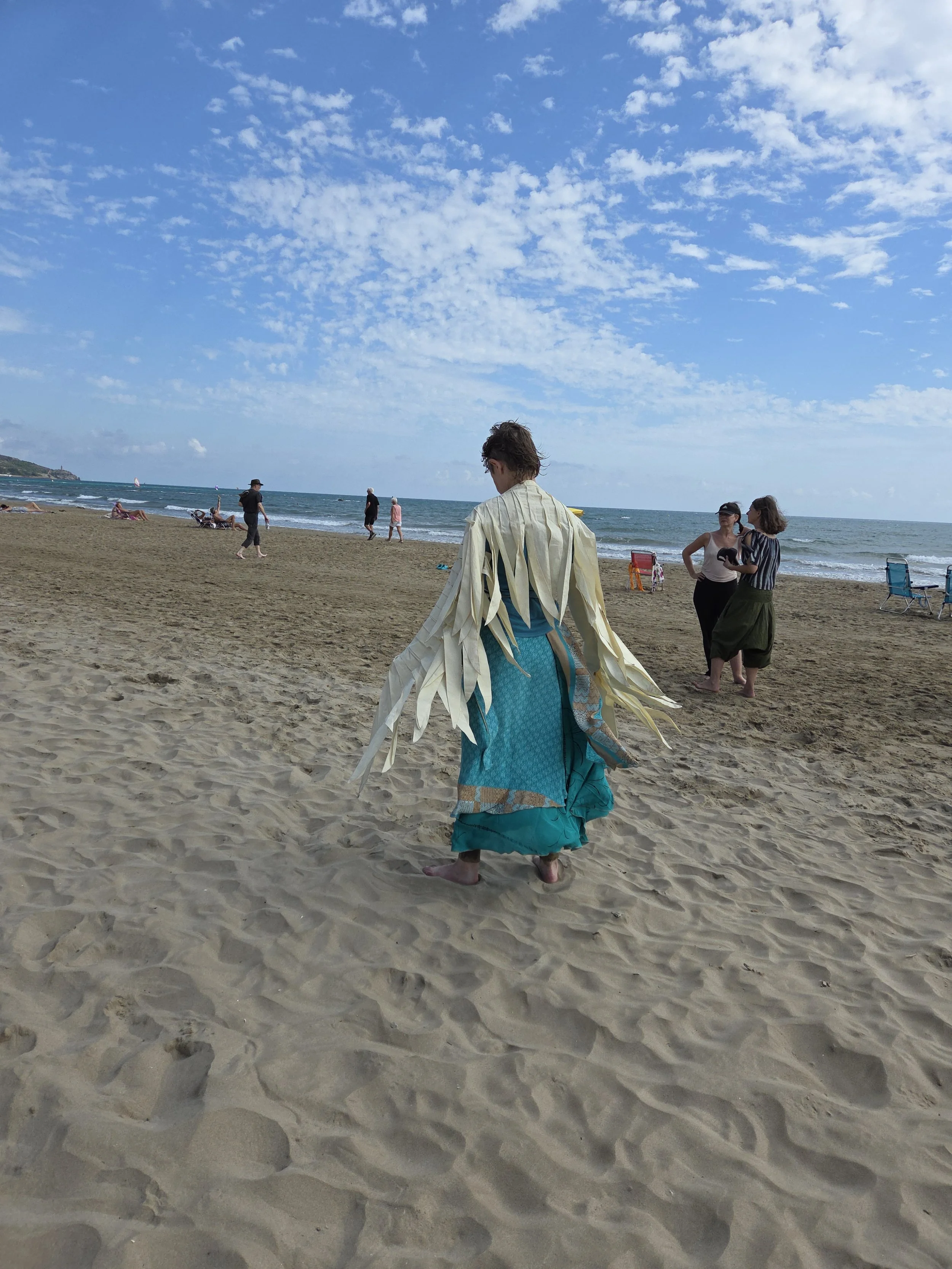
Jenny and the bird costume.
SPAR with me in Spain: Somatics, Self, Other & Beyond
A Workshop Experience at the ISMETA Conference #1
By Crystal Robbins
The first session I attended at the ISMETA conference in Benicassim, Spain was with Jennifer (Jenji) Haycocks (United Kingdom) “Touching Earth: Tuning-in to the Movement of Life.” Vibrantly expressive, in the moment and inspiring, Jenji literally touched ground with gratitude and gave a moving tribute to those whose lands we were on, to the ancestors, to those who came before us. She sensed and named what she was feeling in the space: the mood, the energy, reading not just us, but the space between us as well. She also brought in all living things outside our space like the trees, ocean, animals, birds, grasses and plants, interweaving gratitude and reciprocity. It was clear this was not just a world-view, but a passion and her training tool kit. Her languaging was non-traditional and non-academic. She likened what she calls the “felt-sense" [1] to the intuitive and I quite related to her words, which moved me like artistic renderings or paintings.
She had brought photos, materials and costumes including a majestic birdlike extension of wings which we could choose to engage with at any time. The photos she placed around the room were of animals and nature from around the world. It was clear that “movement of life” was also about all the non-human expressions of life in our world. Was this different? You betcha. But also I was excited to experience a workshop in a different way, that’s why I was here. And this felt inclusive, open, embodied, creative. We all touched ground, we contemplated “how gratitude feels inside… is there a lifting, a lightness, in the heart, or somewhere else?” [2] We moved and let ourselves be inspired by what our senses took in related to all of these things.
Our first led engagement was an introduction task:
Partner up with someone, introduce yourself, and simply share something you felt gratitude towards. This was a brief 2 minute private exchange.
Then we moved to a different prompt:
Why are you here? After 2 min we did a share out as we were inclined, just briefly, maybe 5 people spoke.
Next our third sharing with another partner (a nice way to meet more people) was this:
Stand facing your new partner, eyes closed and simply share with the phrase, “What this body is noticing is….” Or “what this body is sensing is…..” and then name it. For example: “What this body is noticing is its feet feeling the coolness of the floor, what this body is noticing is the flowing of breath through nostrils. What this body is noticing is a tiny pain in the right shoulder” and go back and forth with you and partner. One of the key designs is for the speaker to close their eyes to allow the noticing of sensations to lead vs the eyes. [3]. When acting as listener, our eyes were open. When noticing for ourselves and sharing, we would close the eyes. Then discussion. What did we observe? For me and my partner, we observed that we started very particularly from our immediate selves, in micro observations of self and then our observations grew from within us to a larger relational experience. Our understanding of our bodies grew to include more awareness eventually out into the room. Self, other, and beyond. Hold that thought.
There was yet another partner, our last partner of the day for the biggest experiment.
This next partner was to stand on the opposite side of the room. One row of partners was on one side, one on the other, facing the partner across the room. The task was that one side was going to walk slowly to the partner on the other side. The object was not necessarily to reach that person, but to move towards the person. The person standing still, the receiver, held the cards, not the walker. The receiver was to use their inner sensing inside the body, the gut, their inner world and if they at any time felt a change in their body, they respectfully were to signal in some way. We were coached to notice “ the smallest stirrings, perhaps a movement on the skin, a fluttering of the heart”. [4]. The walker would pause until signalled to continue.
The person who was walking towards the still partner had the task of paying attention, noticing. When the walker felt a sensation that they should stop, they were to honor that impulse, and stop. As the goal wasn’t to reach the person, but to honor the signals from the partner, this was really an experience in connecting to breath, impulse, one’s gut and reading the partner. And then we would switch out.
This last experiment deserves a full examination and is the primary focus of this article. This was such an interesting experiment in paying attention. It was also, I discovered unexpectedly, an opportunity to witness and reflect on Sensation/Perception/Awareness/Response or SPAR in Lessac Kinesensic language. [5]
For those less familiar: SPAR is a key component of Lessac Kinesensics. In simple terms it is a process of learning, self-teaching & understanding. We feel/sense something, we perceive it, with a point of view of what it is, then we have awareness that will often shape our understanding which then elicits a response. For example, I may feel a sensation on my arm, I might perceive that it is a bug. Once I look at it, I may now notice that it is a ladybug and instead of roughly shaking it away, I might gently move it. Taking time to be mindful with awareness, has allowed me to choose a different response. Lessac Kinesensics posits that developing more awareness is key to making any change with wisdom. How often do we go straight to response/reaction, without taking time for awareness? Giving time and space to knowing is also somatic and puts us more in our bodies. The act of noticing the body’s signals, and also employing awareness teaches the body in a biofeedback loop to be more physically aware which aids communication, sense of self and the world around us.
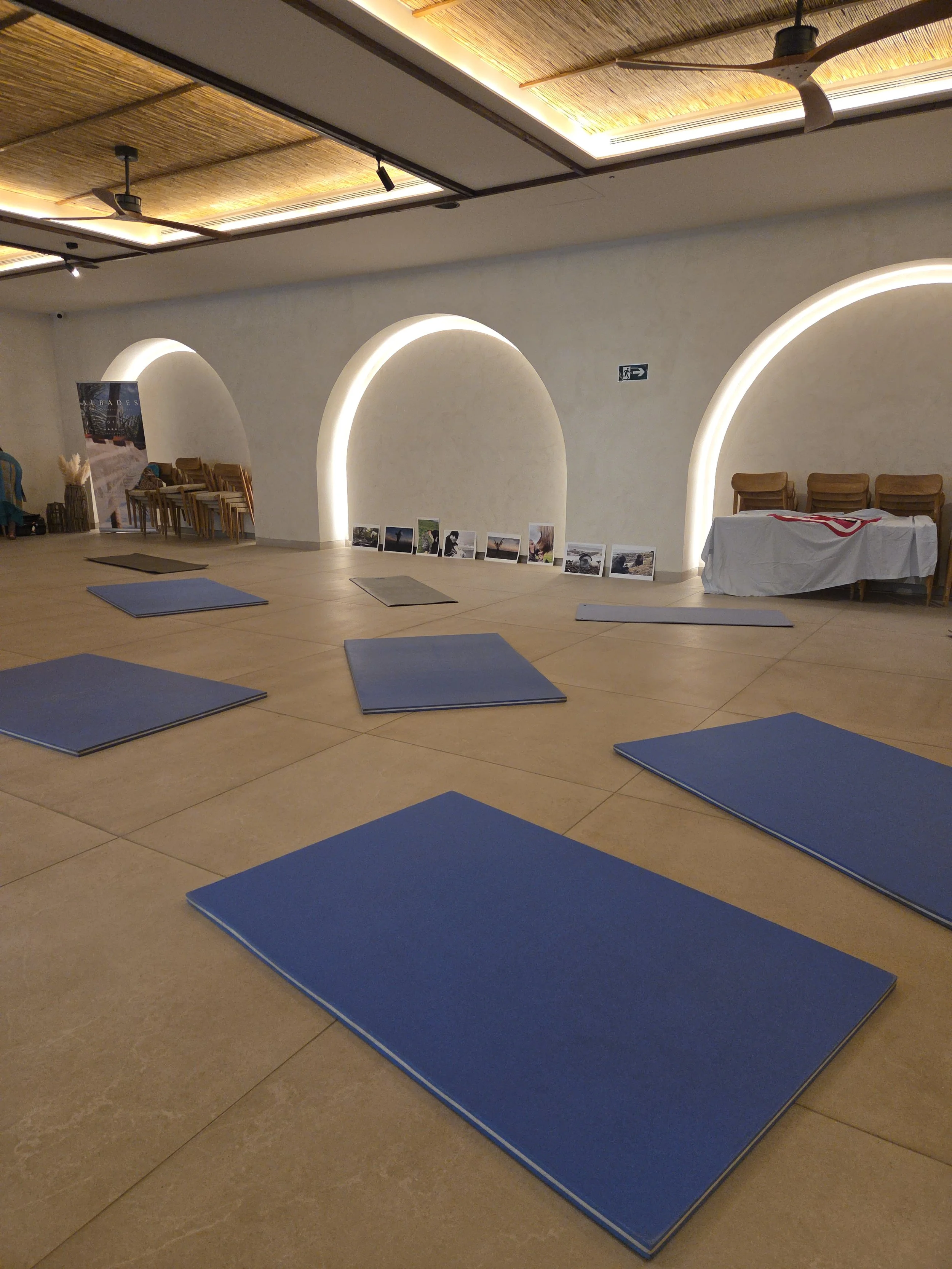
The workshop space at Hotel Albades.
As I was slowly walking towards my new partner, I felt the sensation of my walking in connection/relationship to my partner and the energy between us. I noticed when something changed. There was a different type of breath she took, there was a slight lift to the shoulder, something felt held in the face. I stopped and almost simultaneously she gave me the slightest indication with a raised finger that I should wait. I wasn’t very close to her, so I wondered what I had looked like, or what she had experienced of me that made her want, at such a distance, to stop me. I took a breath, as did she. After a moment, something had settled within her and it felt right to move forward again. I moved forward a little closer, I traveled further this time and she took a deeper breath, shoulders staying up. I stopped. My focus was entirely on her and following signals from her bodily experience of my movement towards her.
The same was happening with everyone on either side of me who were all moving, at varying paces and rates towards the partner across the room. She signaled I could begin again.. As I was walking and was a bit closer, I could now see that she had tears in her eyes, the hand came up. She needed more time. I wondered, is it possible she is really feeling so much from this experiment? What must be going on in her inner belly? Was it me? Was the set of my face too severe, did I remind her of somebody? I took a breath, too. She still had tears, but gestured that I should move forward and so I did hesitantly. My reading of her suggested that I keep coming forward and tears spilled down her face. Then I felt I really should stop. She took some time and moments to breathe and then gestured for me to come. Her tears had stopped. [6]
This stranger suddenly felt like someone I deeply cared about, for whom the thought of wounding at all was unacceptable to me. I was close enough at that moment, that I mouthed, “are you ok?” She nodded. A bit closer. “Do you need a hug?” I asked. We did.
What was this all about? What was happening? What did I represent or did she notice or was she paying attention to in herself that made this the experience that it was? No time to discuss because now she was to walk to me. Surely my experience would be different, I wasn’t fearful of her, we had just had a moment.
Now it was my side of the room’s turn to receive our person walking. She started towards me and got a good third of the way towards me when I felt in the pit of my stomach something I can only describe as a nervousness, an uncertainty. It was completely unexpected. I partially raised my hands, not quite in a ‘no’ or ‘stop’. She stopped, confused. I was confused myself. When the gut regulated itself (I’m guessing) or more specifically, when the feeling dissipated, I put my hands down and she walked again. Every time I got some ‘information’ in my gut, as mentor Arthur Lessac used to reference it, I responded to alert her that something was up. This looked often like one or both hands coming up, but again, I noticed in myself that I wasn’t making it easy on her because my hands were often slightly turned up, in a gesture that could be conceived of as ‘yes’ or ‘come on’, or ‘maybe’ when I meant ‘no’. My signals grew more sure. Reflecting on that now, I can see carryover of this in multiple areas of my life.
Just like when I walked to her, she did finally make it to me and with great relief we just stood, again, tears, and hugged. Why the tears? It felt incredibly intimate to share the experience. First, intimate to simply trust that you can make a choice. And to observe, as I had, that there was perhaps a journey of figuring out what that meant to me. Second, the act of perceiving someone else’s energy is powerful. I wonder how often we really give time to that? Third, the capacity to listen and pay attention that closely and act immediately from the body and know that it will be honored, is something that in my female body was honestly somewhat like a gift, a reclaiming, a healing.
In my personal journaling it also occurred to me that SPAR was organically a part of this process on both ends. As I moved towards her, there was a different understanding and sensing going on, the parts of my body being used were different, the sense of self was different.
I sensed my feet rolling slowly towards her and keyed into the norms of her face and body as I perceived them. (This body is feeling this, this body is noticing this…) When those norms changed, a hand, a face, a breath, the shoulders, I experienced an awareness that that cue was a stopping response. Sometimes I stopped slightly before her hand came up, or at the same time; sometimes I needed her full gesture to come to a stop. The SPAR was related to the subject of her, in relation to me and the space between us. I noticed there was sometimes variation in the time lapse of my perception. Perhaps my P in Sensation-Perception-Awareness-Response had wandered. Awareness felt like a give and take, a partnered experience. As if a sphere of communication enveloped us both. We were mindful of each other. I remember being intensely alive and intensely connected. Can training in SPAR provide the potential for feeling intensely alive and connected to another? And can it extend beyond this workshop on this day? What are the follow-throughs and take-aways of experiencing SPAR somatically?
When I reference her walking to me through a SPAR lens, I can observe those differences, too. Here the first sensing was of movement toward me, followed by a deep unsettling that quite took me by surprise in the pit of my belly. “OOOOOhhhhh” I thought. “THAT’s different, that’s unexpected.” I let her continue walking because I was internally assessing, perceiving, naming for myself the strangeness of this kind of listening, questioning it, and contemplating. I regarded what was happening in the subjective object of me, relating it to the subject of both me and her, and drew a conclusion in awareness. Finally, response: the hands came up.
Then quick as lightning, a new mini-SPAR quick on the heels of that: I noticed the sensations in the body whole. Breath coming faster, a sense of some deregulation, maybe? Flight or fight? I perceived myself quite a bit longer, taking note of my sort of up/open hands and noted awareness had kicked in some automatic counter movement/reactions. Namely breath, I pleasure smelled, I focused on feeling the rhythm of how my torso expanded and leaned on that pace to engage the tiniest bit of buoyancy. I felt the hollows of my knees and the lengthening of the back of neck upward into crown of my head so dynamic alignment could support me. The hands came down. Response had come after my own long used kinesensic experiences for regulating. [7]
In reflecting now, I noticed that each time I felt the deep feeling inside, my senses were keen. I Perceived myself and took stock of what I was noticing, naming it inside, without judgement, because literally my Awareness was enfolding a process of Accepting, Asking and Activating the Response. With SPAR at work, by activating a response, are we close to Activism? This is something I wish to explore. Can we consciously train SPAR in relation to Activism? Response is aligned with Responsibility, yes?
It brings to mind how very true it is that you cannot truly know someone until you walk a mile in their shoes. In this case, I just walked across the room, sensing and feeling someone in the space in relation to me. And what was left for me after that? A deep empathy, a connection, a powerful sense of protection. An embodied sense of being seen and of seeing. A type of knowing that may be incomplete in full knowledge of another but yet understands a vital human component: that we each have the singular right to have a say, and the responsibility to respond with awareness. For a session titled: Touching Earth: Tuning into the Movement of Life, I felt I was definitely experiencing a felt-sense, intuitive connection, a collaboration with more than just the confines of my own body. I felt I was engaging with the self-teaching tool of sensing, perceiving, discovering awareness and choosing response. I tuned into myself, another, and the space in between us. Self, Other and Beyond. The perfect way to start a conference.
With perfect serendipity, my last partner of the conference at the final event just randomly happened to be this same partner. We were both struck by the odds. It allowed us to close the weekend in a way that tied the earlier experience to this last day’s events. We enjoyed a deeper conversation about our take-aways of the week, our journeys, and what was showing up for ourselves in relation to our values and our next steps in life. Self, Other and Beyond. The perfect way to end a conference.
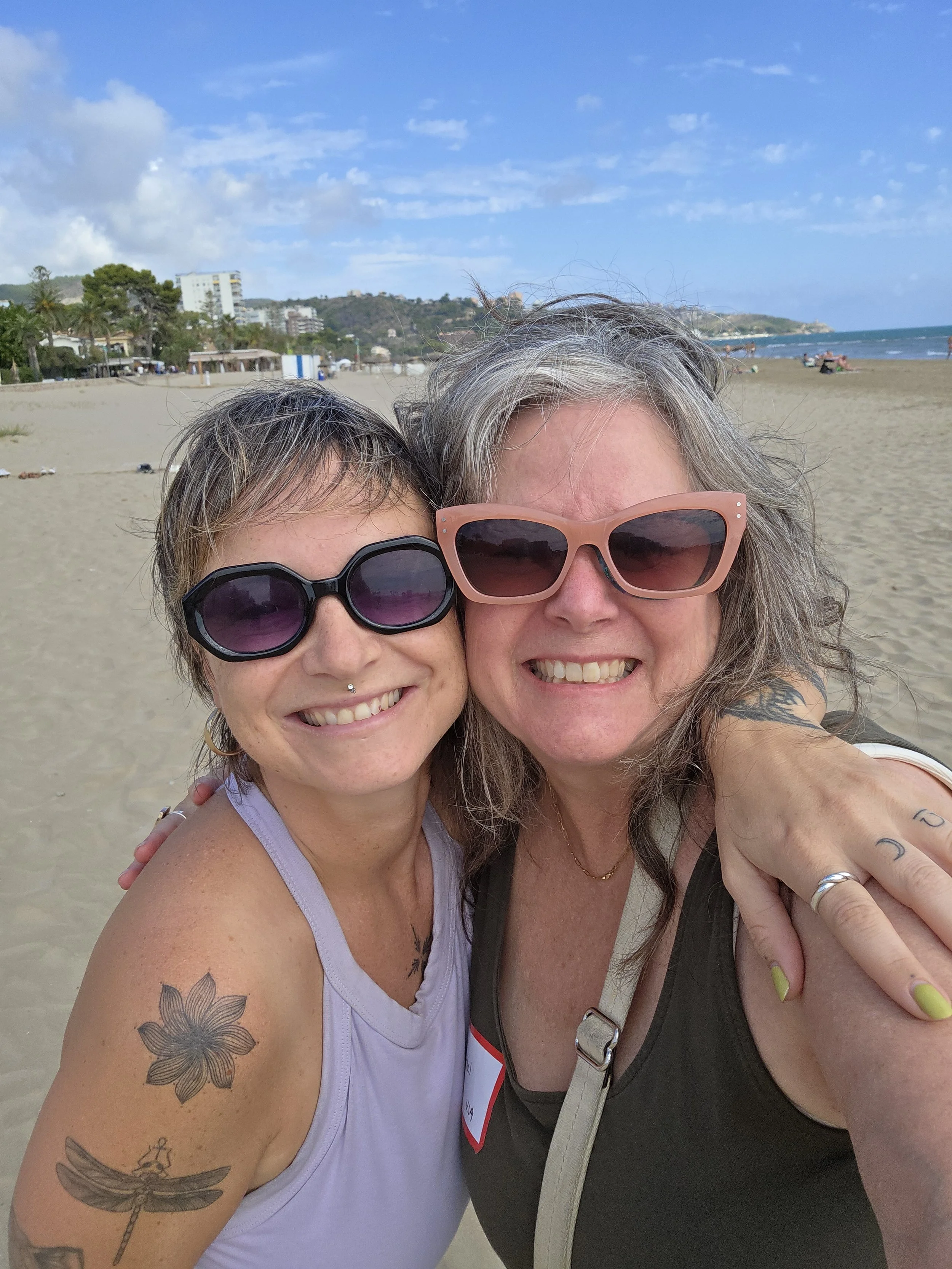
Crystal and partner Bryony Onions.
More information about Jenny Haycocks’ work can be found at www.somatichealth.org. Jenny and Crystal are a part of a new bi-monthly International Embodied Activism group as a spin-off of a workshop offering from the ISMETA Conference in Spain. www.ismeta.org. Lessac Certified Trainers may apply to join ISMETA because the LTRI is an approved training program. www.lessacinstitute.org. But anyone can join the Activism Group, please write Crystal for details: crystal.robbins@lessacinstitute.org
Photo credit above and below: Crystal Robbins. [8]
Stay tuned for follow-up articles on other experiences I had at the ISMETA conference.
SIDEBAR: Practical applications:
It is effortless and easy to have small prompts in an initial workshop or class which rotates the questions/partners/buddies so you meet more people. A prompt like ‘what are you grateful for’ first centers the space in gratitude and also starts one off not with just names, places and bio. ‘What are you here for?’ also grounds the room in common goals. With my large classrooms, opportunities for short introductions that also allow one to meet more people, are always welcomed. And these are easily usable by beginning or advanced classes.
The experience of the next partner with the prompt to name “what this body is noticing….” is an excellent tool for observing and naming what one senses and can feel, which can be grounding; and heightens awareness of self, and ultimately other. Additionally, I adapted this in my dialects class during our British unit, each person used the same prompts, but engaged the dialect of their character to report what they were noticing as self, making the appropriate dialect substitutions, and integrating all the materials of the unit. When I asked for feedback on the experience, it was reported that the improvisational nature of doing this was fun, that they noticed it put them in their actor bodies and their character bodies, sharpened their skills with the newly acquired substitutions, and gave them permission to play in dialect.
As I teach dialects with a good deal of reference to the culture, the land, the food, dance and folksong of a culture, Jenny’s photos and props in the space inspired me to consider collecting physical representative photographs of the land, the topography, the animals and flora and fauna, in the space, not simply in reference study materials online, but to more physically represent in the rehearsal space. Smart classrooms make use of a larger screen with such things, but the inclusion of material goods, like clothing, costume, instruments, and items scattered around the room to explore in a tactile way could encourage new movement/relationship and honoring of the culture of a dialect.
The last experiment is something I could envision doing at an Intensive or with an advanced class or cast, as part of ensemble training and a SPAR training or journey. I can see it also training one’s personal autonomy, personal safety and develop a listening respect for one another.
Less is more. Less is more. Less is more. By keeping the focus of these experiments grounded in a few simple activities, it gave time and space for me as a participant to witness my own connections, reflections and discoveries.
Article Notes:
[1] Jenny: “ ‘felt sense' is a term coined by Eugene Gendlin who brought what we, (emphasis Jenny’s), might call the somatic practice of 'Focusing' ... “A felt sense is an internal aura that encompasses everything you feel and know about the given subject at a given time–encompasses it and communicates it to you all at once rather than detail by detail." –Eugene Gendlin, Email: 11/19/25
[2] Jenny clarified for me the more specific style of prompt she thought she used. Per our discussion: “perhaps it was ‘'how gratitude feels inside?'’ “is there a sense of lifting, lightness, in the heart? somewhere else?’” Email: 11/19/25
[3] Jenny reminded about the importance of closing the eyes in this experiment, not unlike the Lessac explorations with eye masks which invite more information from the other senses. Additionally, she clarified that this was specific training to come into ‘felt-sense’ work and was an exercise developed by Simon McKibbon. Email 11/19/25
[4] Jenny shared: “.a key aspect of this exercise that I invited was that the receiver respectfully motioned their partner to pause every time that they experienced a change in their body. Tiny movements in the body ... perhaps movements in the heart, feelings on the skin …” Additionally, she suggested that this was perhaps my experience of the exploration, others might have different experiences: “to me this exercise may show folks that we are affected by others ... we are in relational co-respondence with other humans, plants, animals, elements all of the time.” Email 11/19/25
[5] Lessac, Arthur The Use & Training of the Human Body, 2019, in the new foreword by Deb Kinghorn; and Lessac, Arthur, The Use and Training of the Human Voice, 1997, first chapter. Both of these sources reference the concepts of Sensation, Perception, Awareness, Response as being integral to one’s organic instruction of self and the art of paying attention: a biofeedback loop that is one of the core Lessac principles.
[6] Later email with Bryony confirmed that her responses were not unlike mine, “I can say reflecting back it was to do with my own processing, it being an intimate exchange with a stranger and just the simplicity of walking towards another human being and sharing energetic exchanges. I don't feel I was overly emotional during this practice, the tears came and went, like emotions coming to the surface and then dissipating”. Email 12/4/25
[7] Lessac bodyvoice regulating tools can involve a pleasure smell, sensing a floating sensation, softening the knees to engage with a long parenthesis spine to assist with the alignment which supports optimal breath. See Lessac’s Use and Training of the Human Voice, 1997, 3rd edition, chapters 1-4 for body pain relievers, body energies and practical tools for sensing optimal alignment.
[8] Permissions received for both parties mentioned/photographed here.
Author: Crystal has explored Lessac Kinesensics since 1998. She is teaching privately and at Santa Monica College, UCLA Extension, Burbank Unified and with the elder care social platform called UniperCare. She mentors new trainers and is working collaboratively with her daughter, Maeve, who is currently applying Kindersensics at Santa Cruz Waldorf.
Paella Pan Art.